


 EN
 ไทย


Customers Also Purchased


Cable Tie They may be something many people take for granted, but in electrical work, system installations, and actual industrial applications, "heat" is a crucial factor that affects the lifespan of cable ties much more than many realize. This is especially true in areas with accumulated heat or extreme temperature fluctuations, such as near motors, engine compartments, electronic enclosures, outdoors, or around hot piping. If you don't match the cable tie to the application, no matter how tightly it's fastened, continuous heat exposure will always cause it to become brittle, crack, or fail prematurely.
In the market, there are many types of cable ties: Nylon 6/6, UV-stabilized nylon, ETFE known for chemical resistance, up to stainless steel cable ties engineered for extreme environments. Each material is formulated to handle different temperatures and tasks. Understanding "material limitations" is therefore much more important than choosing based on price, color, or familiarity. Nong Chang has rounded up the 5 types of cable ties that truly offer the best heat resistance, ranked from "most durable" down to the runners-up, along with a materials science explanation of how each type's "temperature range" differs—such as -80 to 500°C or 105–120°C—and why these numbers aren't single points, but ranges you need to understand.
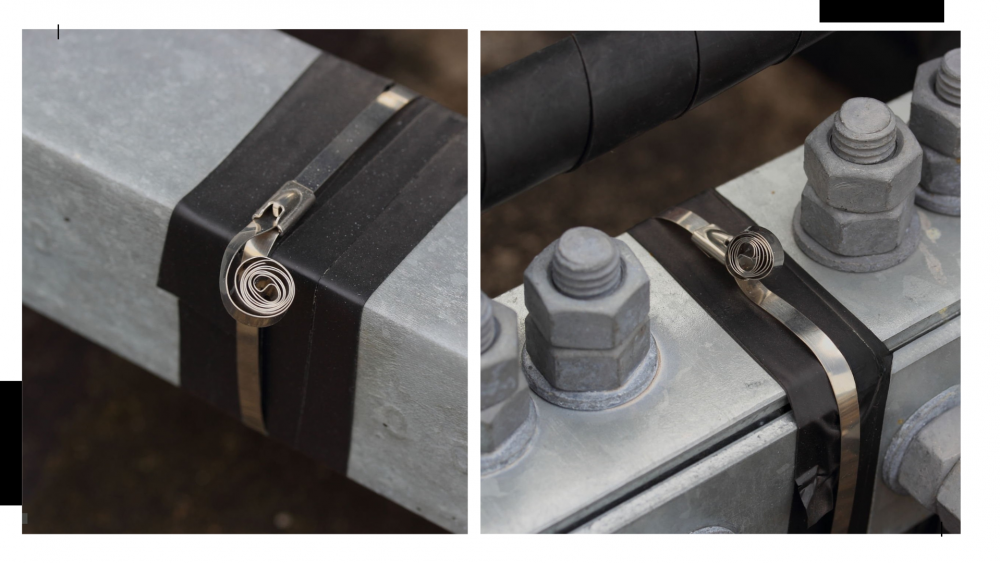
Rank 1 — Stainless Steel Cable Ties
Heat Resistance: -80°C to 500°C | Material: Stainless Steel 304 / 316
Stainless steel cable ties represent the pinnacle of heat resistance that "nothing can surpass." Because they are not made of plastic in the first place, they do not suffer from softening, loss of tensile strength, or micro-cracking when exposed to high heat or extreme cold. The crystal structure of stainless steel is exceptionally stable, with a melting point around 1,400°C, easily withstanding continuous use at 300–500°C without deformation or elongation that could compromise performance.
In addition, stainless steel offers outstanding resistance to chemicals, seawater, moisture, and acidic or alkaline environments. This is a key advantage consistently confirmed by numerous manufacturers' representatives. This is precisely why stainless steel cable ties are selected for use in refineries, chemical plants, petrochemical facilities, and harsh environments where both heat and corrosion resistance are required simultaneously.
Key Advantages of Stainless Steel
- Maintains structural strength even at high temperatures
- Unaffected by sudden temperature changes
- Performs well in harsh environments (hot vapors, oils, chemicals)
- Lifespan is several times longer than plastic types
Limitations
- Requires pliers or a tensioning tool
- Not as flexible as plastic
- Higher price than nylon types
However, when it comes to "zero-risk heat resistance," stainless steel cable ties are undoubtedly the safest choice.
No. 2 — High Temperature Nylon (PA46)
Heat resistance: 150–200°C Material: Polyamide 46
If you need high heat resistance but still want the flexibility of plastic cable ties, PA46 is a top recommendation. It is a nylon specially developed to truly withstand high heat without easily softening or losing tensile strength like standard PA66. The molecular structure of PA46 is more crystalline, meaning thermal deformation occurs much more slowly, and it retains excellent material toughness even in environments with continuous heat throughout the day.
PA46 supports temperatures around 150°C continuously and can withstand even higher temperatures for short periods without deforming enough to compromise its holding strength. This makes it ideal for demanding applications near hot motors, in engine compartments with constant hot airflow, or inside poorly ventilated control panels.
The balance between high heat resistance, flexibility, and and easier installation than stainless steel makes PA46 a solid "middle-ground" choice for industrial applications requiring both safety and ease of use.
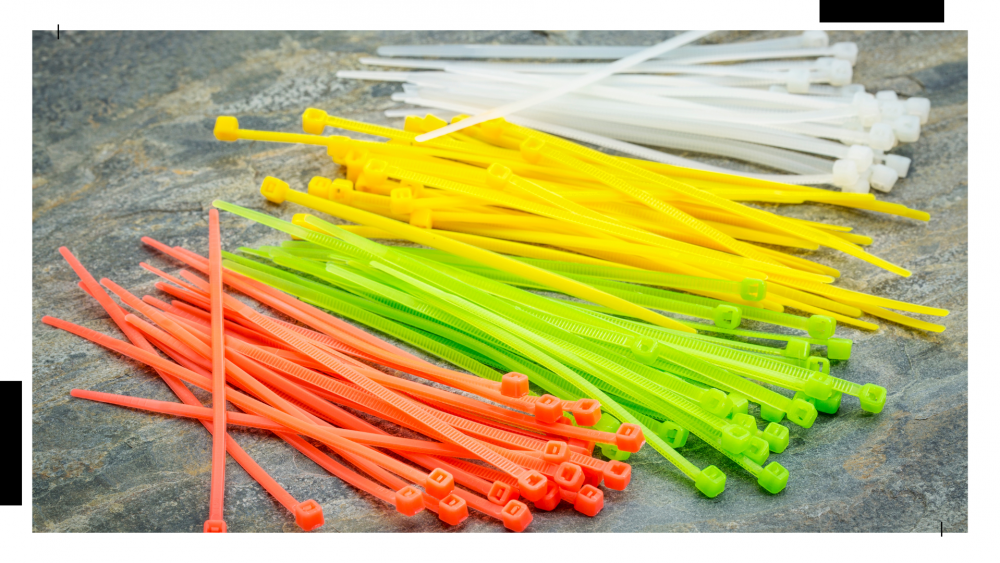
No. 3 — Heat-Resistant Grade PA66 (Heat Stabilized PA66)
Heat resistance: 105–120°C Material: PA66 + Heat Stabilizer or Fiber Reinforced
Standard PA66 withstands heat up to around 85°C, which is insufficient for electrical or industrial tasks with continuous accumulated heat. Therefore, "heat-resistant grade PA66" was developed by adding heat stabilizers or reinforcing fibers to make the material structure more stable. This increases heat resistance up to about 105–120°C while maintaining good toughness and strength.
The highlight of this cable tie group is its ability to "continuously withstand moderate heat" without becoming brittle or quickly losing tensile strength like regular nylon. It is well-suited for use in control panels with circulating hot air, near motors where temperatures fluctuate throughout the day, or in areas that aren't extremely hot like heavy machinery, but warm enough to cause standard cable ties to degrade rapidly.
Technician's recommendation: If the application temperature is in the "warm but continuously hot" range, such as near motors or inside unventilated control panels, heat-resistant grade PA66 offers the best value. It does not require a budget as high as PA46, yet provides sufficient heat resistance for actual operating conditions.
Rank 4 — UV Resistant Cable Ties (UV Resistant PA66 + Carbon Black)
Heat resistance: 105°C Material: PA66 + Carbon Black / UV Stabilizer
UV resistant cable ties are specifically designed for outdoor applications because Carbon Black is added to help reduce degradation from UV rays, making their service life much longer than standard models when exposed to all-day sunlight. In terms of heat resistance, however, the primary material remains PA66, capping its limit at around 105°C, a stable specification since its formulation has not been significantly altered to increase heat resistance.
Many people mistakenly believe that "black = heat resistant," but in reality, "black = sun/UV resistant." Heat resistance still strictly adheres to the nylon specification. Therefore, this model is ideal for outdoor installations that are not directly exposed to hot pipes or machine heat, such as outdoor cable trays, outdoor CCTV camera systems, or solar rooftop systems.
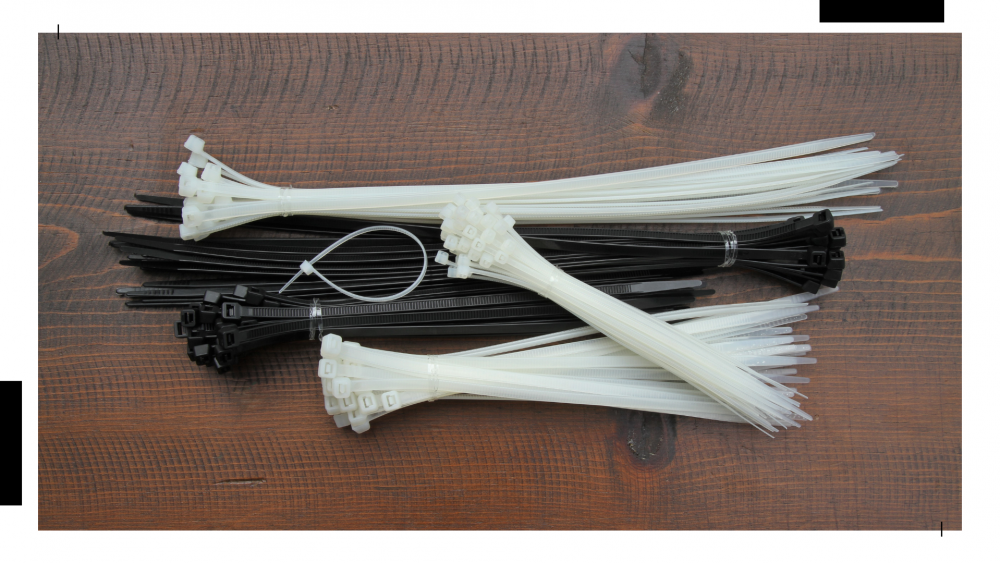
Rank 5 — Industrial Grade Nylon 6/6 Cable Ties (High-Grade Nylon 6/6)
Heat resistance: 90–105°C Material: Nylon 6/6 (higher grade than standard models)
Industrial grade nylon cable ties are engineered to offer greater strength and thermal stability than standard versions. While retaining the flexibility and ease of use characteristic of nylon, the material density has been enhanced, allowing it to withstand higher temperatures of approximately 90–105°C, compared to standard nylon cable ties that typically begin to soften as temperatures approach 85°C.
This model is suitable for applications without extreme heat that still require moderate continuous thermal durability, such as electrical panel installations, wire management near light machinery, or areas with elevated ambient temperatures. While not offering heavy-duty industrial heat resistance like PA46 or heat-resistant PA66, it provides significantly better cost-performance value than standard nylon.
The advantage is an affordable price with superior quality compared to standard models. This makes it an ideal choice for applications that demand increased durability without yet requiring high-temperature nylon materials.
For high-heat applications, always select strictly by material.
Each material has a different temperature ceiling, directly affecting service life, safety, and the overall cost-effectiveness of the installation. Therefore, before choosing, Cable Tie you should start by "knowing how hot the application gets" and then select the most suitable material.
Heat Resistance Ranking: Highest → Lowest
- Stainless steel — Resists up to 500°C
- PA46 (High Temp Nylon) — Supports temperatures of 150°C and above
- Heat-resistant grade PA66 — Supports the 105–120°C range
- UV Resistant PA66 — Withstands approx. 105°C, but excels at sunlight resistance
- Industrial grade Nylon 6/6 — Withstands approx. 90–105°C, suitable for general applications with moderate heat
If you really need to work in high-heat areas, Nong Chang recommends starting with Stainless steel or at least you should choose PA46 As for outdoor work that doesn't come in contact with hot pipes but endures strong sunlight all day, choose UV Resistant PA66 will provide the highest durability and the longest service life.