


 EN
 ไทย


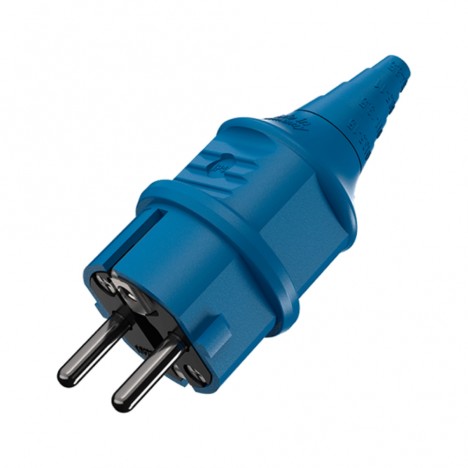


PPower Plugs These are the large, chunky red or blue plugs that make anyone wonder, “Why do they have to be so big?” and “How are they different from regular household plugs?” At first glance, they seem to serve the same purpose—just plugging into power, right? But the reality is completely different. In the electrical world, small connection points like plugs are often the unsuspected root cause of major disasters.
The domestic plugs we use every day are designed for convenience and aesthetics in daily life, capable of handling only standard household loads. But when exposed to real work conditions involving heavy power draw, dust, water, or hours of continuous operation, they start to fail. The contact terminals overheat, the plastic melts, or they become loose and easily generate sparks.
In contrast, industrial power plugs are built to be “secure, durable, and safe” for high-draw machinery and equipment. They feature twist-lock mechanisms to prevent disconnects, large contact areas, heat-resistant materials, and IP67-rated waterproof and dustproof seals. You could say they were born for high-current job sites, ensuring small issues never turn into major accidents.
Therefore, when asking "How do industrial power plugs differ from household plugs?", the answer isn't just about their size or color—it's about their completely different "functions" and "safety" capabilities.

Household Plugs: Designed for Convenience, Not Durability
The standard household plugs we see every day are designed for low-power domestic appliances such as fans, rice cookers, irons, TVs, or computers. Their average rated current ranges from 10 to 16 amps on a 1-phase 220V system, which is plenty for daily life. They are made from standard plastics like ABS or PVC, lightweight, with small flat or round pins that offer minimal contact surface area to keep them easy to plug in and affordable to manufacture.
However, household plugs completely lack durability in harsh, real-world work environments because they aren't designed to withstand high heat, moisture, dust, or oil. Due to their small contact surface area, continuous current flow over long periods causes heat buildup around the pins. Especially when powering high-wattage equipment like hair dryers or irons for extended periods, the heat softens the plastic, loosens the contacts, and eventually creates an arcing point that can easily ignite a fire faster than you might think.
Household plugs also lack locking mechanisms or protective dust covers. A simple tug on the cable can easily pull them loose. Once loose, minor flickering might seem harmless, but technically, it means the current is "arcing" across the air gap. These micro-sparks gradually erode the contact points into black carbon residue and continually build up heat without you realizing it.

Industrial Power Plugs: Built for High Current and Harsh Environments
Industrial plugs, commonly known as "power plugs," are electrical connectors designed to handle higher currents and withstand heavy-duty use. Their construction is several times thicker and sturdier than household plugs, made from polycarbonate or glass-filled nylon that resists impacts, heat, and chemicals. The large, round pins maximize the contact surface area for current flow, reducing heat buildup and enabling them to handle maximum current ratings from 16A up to 125A.
The most visible feature is the "twist-lock" system, which ensures a tight, secure fit into the socket. Once twisted, the pins lock into place and won't disconnect even under cable tension. Additionally, every power plug features waterproof seals and dust covers, meeting ratings from IP44 to IP67. This means certain models can withstand splashing water or even temporary submersion, making them ideal for environments with dust, oil, or unpredictable weather—such as metal fabrication plants, food processing factories, construction sites, or warehouses.
A power plug acts like a safety device for the electrical system, preventing electrical leakage, short circuits, and fires that typically originate from loose connections or plugs unsuitable for the load. To put it simply: a household plug is like wearing slippers indoors, while an industrial power plug is like safety boots built to tackle water, dust, and heavy-duty working conditions.
Why Do Plugs Burn Out? A Question Every Technician Should Understand
The primary cause of burned plugs is heat buildup at the contact points, which usually starts from using a plug rated below the actual load. For example, if a welding machine draws 25 amps but is plugged into a 16-amp household plug, the generated heat will build up until the plastic softens and melts. Furthermore, factors like loose terminals, metal degradation, and accumulated dust inside the plug slots increase electrical resistance, forcing more energy through the connection point and driving temperatures even higher.
Industrial power plugs are specifically designed with larger contact surfaces and higher contact pressure, preventing looseness and minimizing electrical resistance. The conductive pins are made of pure brass or copper, which conduct electricity efficiently and resist overheating. Some models even feature internal pressure contact systems to maintain a tight connection no matter how many times the plug is inserted and removed.

IEC 60309 Standard (and TIS 166): The Universal Language of Plugs Worldwide
In the past, industrial plugs differed in size and connector pinouts from country to country and were not interchangeable, causing safety and compatibility issues across borders. This led to the creation of the international standard known as IEC60309 to standardize the shapes, sizes, and colors of industrial plugs worldwide. This standard does not just dictate that “plugs must be durable,” but goes into detail specifying pin angles, keyway positions, and pin spacing so that plugs of different voltages can strictly never be cross-connected.
What most people recognize easiest is the “plug color,” because color is the universal language indicating voltage: blue is used for 1-phase 230V systems, red for 3-phase 400V systems, yellow for 110V systems commonly used in construction or stage lighting, and black for specialized systems with voltages exceeding 500V. Each colored plug has different pin dimensions and keyway positions, completely preventing plugs from being inserted into mismatched voltages and providing 100% protection against accidental cross-voltage connections.
Thailand also officially adopts this standard under the reference TIS 166-2549, which is equivalent to IEC60309 in every respect. Therefore, whether a plug is manufactured in Europe or Asia, as long as it bears the IEC60309 or TIS 166 marking, it is fully compatible for immediate use.
| Color | Electrical System (Example) |
|---|---|
| Light blue | 1-Phase ~230V (General-purpose plugs / 1-phase power tools) |
| Red | 3-Phase ~400V (High-power motors / heavy machinery) |
| Yellow | ~110V (Construction sites / stage work, focused on user safety) |
| Black | Special systems with voltages over ~500V |
Phase Systems & Pin Counts: Match Them to Your Equipment
Industrial plugs do not come in just one configuration, because factory and jobsite electrical systems include both 1-phase and 3-phase supplies. If your equipment uses 1-phase power, the plug will have 3 pins: live (L), neutral (N), and ground (PE). A 3-phase system, on the other hand, has 4–5 pins, adding separate L1, L2, and L3 lines to divide power phases—ideal for motors or machinery requiring higher power. 3-phase machinery draws power more evenly and delivers higher torque, requiring purpose-built plugs that cannot be interchanged with domestic plugs.
When technicians select plugs, they must match them precisely to the actual power system. If the equipment specifies 230V 1-phase, choose a blue plug; if it is a 400V 3-phase machine, always choose a red plug. This is not about bolder colors, but because they are specifically engineered to match that particular voltage system.

How to Choose the Right Industrial Plug for Safety and Performance
Choosing an industrial power plug is not just about price—it requires considering both the “actual electrical load” and the “on-site environment.” First, check the maximum current rating of the equipment. For example, if an appliance draws 25A, you should choose a plug rated at 32A or higher to allow a safety margin. Do not use a plug with an exact rating match, as continuous operation can easily cause the plug to overheat.
Next is the IP protection rating. For indoor use or dry areas, IP44 is sufficient. However, for outdoor work or locations frequently exposed to rain, choose IP67 for optimal safety. In addition, consider the plug's material: for work exposed to direct sunlight or UV radiation, choose plugs made of genuine polycarbonate, as it resists cracking and fading.
Finally, verify standard certifications. Avoid plugs that do not display IEC60309 or TIS 166 markings on the body, as these guarantee the product was truly designed to international standards. Without them, pin dimensions and voltage ratings may not match the system properly, posing a serious risk of short circuits or electric shock.
Where Are Industrial Plugs Used in Real Life?
Industrial power plugs are commonly used in many places without us even realizing it: in manufacturing plants to power main machinery, motors, or large compressors; on construction sites to connect welders, rebar cutters, or high-intensity floodlights; in warehouses or cold storage facilities with heavy refrigeration units; as well as at events, concerts, or stage setups that rely on low-voltage 110V systems for operator safety.
All of these places share one thing in common: "They need plugs that are safe and reliable in any environment," and industrial power plugs are the answer to that challenge.
Industrial plugs aren't just for factories
Many people assume that power plugs are exclusively for factory or machinery work. In reality, these plugs can be used in general field applications, such as temporary lighting setups, event booths, garden pump operations, or backup power systems for large residences. Thanks to their UV-resistant, water-resistant, and secure connection features, they are far safer than household plugs—especially when power needs to run around the clock.

A small component at the heart of the electrical system
A plug might seem like a minor part of an electrical system, but in reality, it's the point that must carry the entire electrical current. If this connection isn't good enough, nothing downstream is truly safe. Industrial power plugs aren't used simply because they look nicer or more professional, but because they represent a "safety standard" that genuinely reduces the risk of electrical fires or shocks.
Don't assume that "any plug works the same," because the answer is that they are completely different. Choosing the right plug for the job prevents future problems starting today. If your work involves high-power tools or takes place in areas frequently exposed to moisture, dust, or water, switching from household plugs to industrial power plugs is the best decision—definitely safer, more durable, and more cost-effective in the long run.