


 EN
 ไทย


Customers Also Purchased




Have you ever... walked into a safety equipment store and seen rows upon rows of safety helmets, ranging from a few hundred to over a thousand baht, and secretly thought to yourself, "Hmm... how are they actually different?" Some look so identical it's confusing, yet their prices differ by almost double! When asking the staff, they give similar replies like "It's genuine, sir" or "It's factory grade." Both sound good, but you can't help wondering, where is the real difference? And how do we know if the safety helmet in our hands is "genuinely authentic and truly safe," not a knockoff that might crack on the very first impact?
We've experienced this ourselves. Back then, we just wanted to buy Safety Helmet for use on small jobsites. But once I got to the store, I couldn't decide because all the safety helmets looked practically identical—the only differences were the logos and the prices. Eventually, I spoke with a technician in the store who told me, "Spotting a genuine safety helmet isn't hard, mate. You just have to know where the hidden signs are." That comment was what piqued our interest, leading us to discover that the difference between a quality helmet and an imitation goes far deeper than meets the eye.
In this article, we'd like to share what you should check thoroughly before buying a safety helmet so you don't accidentally end up with a sub-standard product.
Always check the safety helmet's standard certification marks first
Every certified safety helmet must have an industrial standard mark (TIS), or if it is imported, international standard marks such as ANSI (USA), EN (Europe), or JIS (Japan) clearly affixed to the safety helmet. They are usually found inside the helmet shell or stamped along the inner rim of the helmet. Take a close look and you will see these codes.
- TIS 368-2554 for industrial safety helmets in Thailand
- ANSI Z89.1 Type I/II for US standards
- EN 397 for European standards
These codes are proof that the safety helmet has genuinely undergone testing for strength, impact resistance, penetration resistance, and suspension systems. Passing these requires multiple rigorous testing stages, including drops from heights and repeated strikes from solid objects.
However, if a safety helmet has none of these marks at all, or only features blurry prints like a cheap, vaguely placed sticker, assume right away that it does not meet the standard. Sometimes, an "unrealistically cheap price" is a clear warning sign that it is definitely not genuine. Authentic, certified safety helmets are not expensive because of the brand name, but because "they have been tested to guarantee real safety."
Precautions when using a safety helmet: improper use can be dangerous No matter how certified a helmet is, improper use—such as not tightening the strap, leaving it in the sun until the material becomes brittle, or continuing to wear a helmet that has already sustained a severe impact—can lead to real danger.

Inspect the safety helmet's suspension: the true impact-absorbing component
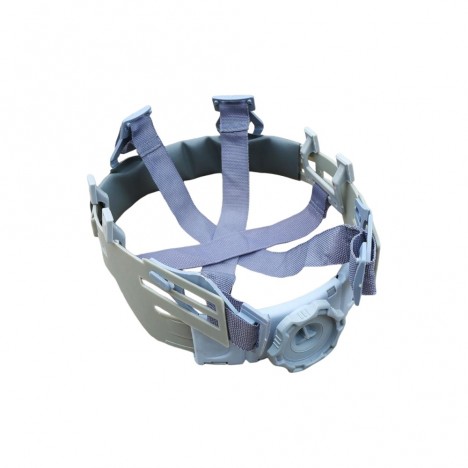
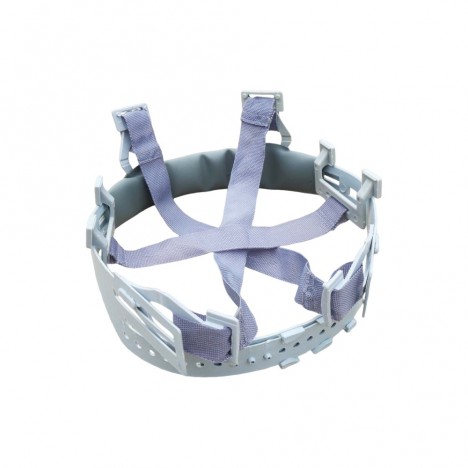
When choosing a safety helmet, many people only look at the exterior first—whether the color looks nice, the logo is clear, or if it looks sturdy. But the most commonly overlooked feature is the helmet suspension. In reality, it is the "beating heart" of safety. When an object strikes the helmet, protection does not rely on the shell alone; the impact force is transferred down into this suspension. A good suspension is flexible and absorbs the shock, preventing the force from directly impacting the skull, much like a car's shock absorbers.
A genuine safety helmet will feature a 4-point or 6-point suspension made of high-quality nylon or polyester straps that are both tough and resilient. It also includes an adjustment mechanism to ensure the helmet fits snugly around the head, regardless of head size. Furthermore, the crown area includes a cushion pad for added comfort during long hours of wear, making it comfortable and headache-free.
- The suspension is thin, loose, or lacks any adjustment system
- The straps are very stiff, causing immediately noticeable, painful pressure on the head
- There is no crown pad, or if present, it is made of thin foam that detaches easily
Try this simple test: put on the safety helmet and gently nod your head up and down. If it is genuine, the helmet will fit snugly without feeling overly tight, allowing natural movement. But if it is counterfeit... just tilting your head will cause the helmet to shift, and with stronger movements, the helmet might even fall completely off your head.

Safety helmet materials: ABS or HDPE—genuine materials must not be brittle or excessively thin
Another point that many people are unaware of, yet is extremely crucial, is the material of the safety helmet. The material used to manufacture a safety helmet determines whether it will "crack" or "withstand the impact" when struck by falling objects. Standard-compliant safety helmets use materials like ABS (Acrylonitrile Butadiene Styrene) or HDPE (High-Density Polyethylene), which are specialized plastics that are exceptionally strong, flexible, and highly impact-resistant. Under a heavy blow from a falling object, the safety helmet will not shatter immediately; instead, it will "flex slightly" to absorb the force before springing back into shape, just like a quality car bumper.
However, substandard items… mostly use cheap recycled plastic that is very thin and brittle. Sometimes you can tell just by touching it that it feels unusually light. When held up to the light, you can see tiny air bubbles in the plastic material or cloudy white marks from poor molding, meaning the helmet shell isn't dense, and when subjected to a hard impact, it has a high chance of "cracking immediately" without any shock absorption at all.
- If it's genuine, the sound will be "dull and solid," like tapping on a solid, weighted object.
- But if it's counterfeit, the sound will be a thin, hollow "click," like tapping on toy plastic.
Chin straps and anchor points: Standardized products are meticulous down to the stitching.
Another point I’d really like everyone to look at, which is often inadvertently overlooked, is the helmet's chin strap. Many people might think it's unnecessary and wearing the helmet loose is enough. But in reality, the chin strap is a small thing that genuinely saves lives, especially when working at heights, such as climbing steel frameworks, walking on bridges, or being in areas where you constantly have to bend down and look up. Because no matter how good the helmet is, without a chin strap, it's ready to "fall off" at any moment.
Safety helmets will have chin straps made of high-quality nylon or polyester—strong and not prone to rotting—and the stitching points must be very secure, with no loose threads or fraying seams. The hooks or buckle clips will use good-grade materials, such as rust-proof coated metal or industrial-grade plastic that doesn't easily turn brittle and break. The buckle also adjusts tightly and securely without slipping on its own during use. But with fakes… it’s clearly visible.
- Rough stitching that breaks easily, tearing apart with just a light tug.
- Loose straps that won't lock no matter how much you adjust them.
- Some models don't even include a chin strap at all.

Weight and wearing feel: The differentiator between genuine products and counterfeits.
Finally, I'd like to leave you with something that almost every technician says: "With genuine items, you can feel the difference just by wearing them." It might sound like a joke, but if you've ever actually tried it, you'll know it's absolutely true.
A good-quality safety helmet feels good from the moment you put it on. When you pick it up and wear it, you will immediately feel the balanced weight—no tilting, no wobbling, not front-heavy, and not pinching the sides of your head. Once the suspension harness is adjusted properly, the helmet sits perfectly on your head, as if it were custom-made just for you. Plus, when worn for long hours of work, it doesn't feel uncomfortable because the internal harness system balances and distributes the weight across your entire head. But with substandard ones... just trying them on for the first time starts to feel "wrong."
- Some are abnormally heavy because they use thick, inflexible plastic.
- Some are so light it feels like the helmet could fly off at any moment.
- The contact points with the head are hard without padding, causing headaches when worn for long periods.
We once tried comparing them ourselves, wearing a standardized one and a substandard one on each side (just testing for fun at the time). The result was that in less than ten minutes... the substandard side started to cause temple pain from pressing down hard, and it felt unstable, like the helmet was about to slip off all the time.
Another method to try is to put the helmet on and tilt your head down, back, or turn left and right. If the helmet wobbles with your head's movement or makes a "clicking/rattling" noise from the harness, that means the helmet isn't secure enough or the suspension harness is of poor quality. In a real situation, if something falls on you, that kind of helmet may not be able to absorb the impact at all.
Conclusion
In the industrial world, safety is something you can never be careless about. Don't look at it as just a small thing, because on the day the unexpected happens, a single standardized safety helmet... might be the reason you get to return home safely after work every time.