


 EN
 ไทย


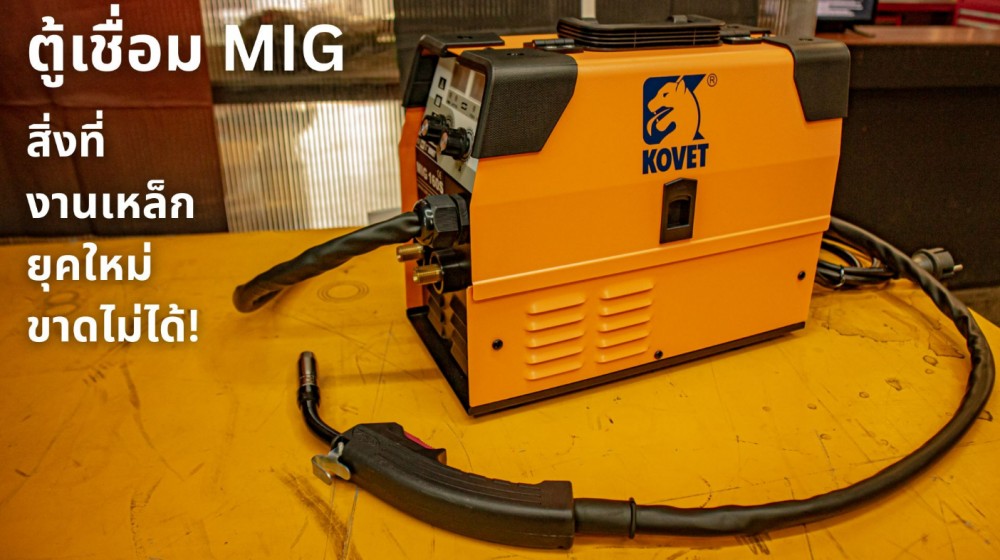
Have you ever thought that MIG welder it's only suitable for large factory jobs? Many people might view it as a specialized tool strictly used in industrial lines, but that's really not true. I used to think that way too, until the day I saw it in action and realized that this welding machine was designed to make welding much more accessible—in terms of efficiency, convenience, and precision.
Once you actually see a MIG welder at work, you'll understand that they aren't just bulky machines. Nowadays, there are compact units featuring smart IGBT systems and continuous wire-feeding technology that provide smoother, more uniform weld beads than standard welders ever did. With a steady, uninterrupted rhythm, metal welding becomes much easier to control, allowing even complete beginners to learn quickly.
And what else? Why have MIG welders become an indispensable tool today?
In this article, I will introduce you to MIG welding machines in more detail, exploring the inner workings of the MIG system and helping you move past the idea that it is complicated or only suitable for industrial factories. Nowadays, MIG welders have truly taken center stage in modern metalworking. So, let's take a look at why this has become a must-have tool for both professionals and DIY enthusiasts to have in their workshops or at home.
Why Are More People Turning to MIG Welders?
A MIG welder is a welding machine that uses a continuous wire electrode combined with a shielding gas (such as CO₂)—or it can operate gasless in models that support flux-cored wire—eliminating the need to frequently change electrodes like with stick (MMA) welding machines.
Simply put, it makes welding significantly easier because the MIG welding system continuously feeds wire and electricity, allowing the user to maintain a steady and consistent weld bead. The wire feeds automatically, eliminating the need to pause or change rods frequently, resulting in smooth, clean welds suitable for both beginners and professionals who prioritize precision in their work.
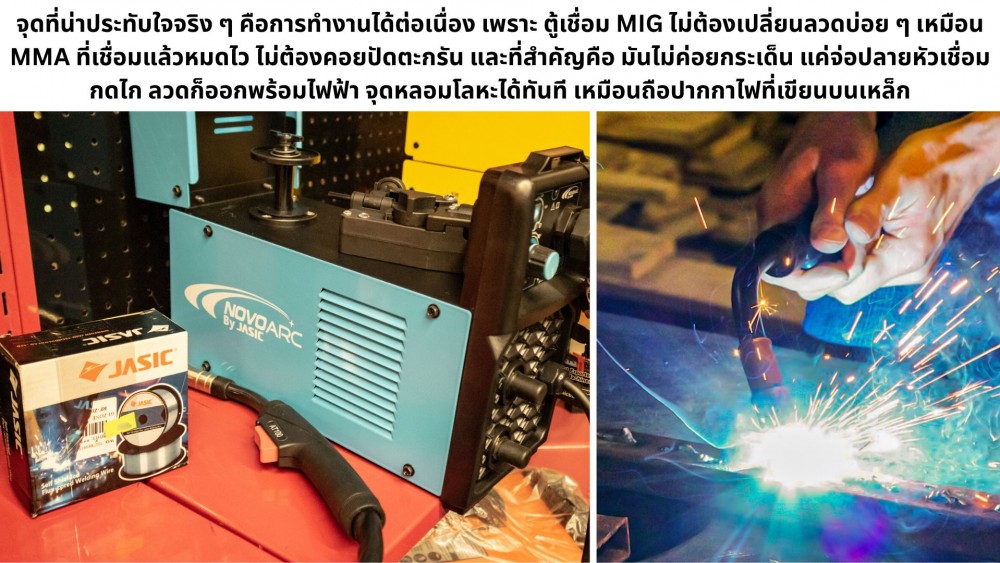
of 7 Factors for Choosing the Right MIG Welder for Your Work As you can see, MIG welders are truly ideal for modern steel fabrication—so much so that some even call them the welding machines of the future—and we will undoubtedly see them used more frequently going forward. Let's explore why.
Why Are MIG Welders Ideal for Modern Metalworking?
In the past, most metalworking was confined to large factories or industrial sites. However, everything has changed with modern technology. Today, we have designer metalwork, decorative pieces, metal art, or home appliance repairs that require metal welding with smooth, clean beads that minimize grinding. This is precisely where MIG welders shine, such as in:
1. Fast, Smooth, and Time-Saving Welding
MIG welders use a continuous wire feed system, eliminating the need to stop and swap out electrodes like with stick welding. You can weld several continuous meters of steel without interruption. It is noticeably faster and produces far cleaner results.
Additionally, it makes controlling the weld bead much easier because the heat output is continuous and consistent, preventing interruptions in the weld seam. This significantly cuts down welding time, especially for high-volume production or large steel frameworks.
2. Beautiful Weld Beads Ideal for Exposed Metalwork
The weld beads produced by a MIG welder are smooth, uniform, and slag-free (since shielding gas is used instead of flux), requiring minimal grinding and rarely suffering from porosity. This makes it ideal for work where the welds are meant to be seen. Furthermore, techniques can be adapted to create unique patterns, such as weaving to reinforce joint strength—a hallmark look in Industrial Loft style decor.
3. Easy to Use, Even for Beginners
Operating a MIG welder does not require as much arc control or arc length management as stick welding. Simply adjust the voltage and wire feed speed to match the steel thickness, position the welding nozzle 1–2 cm away, and you are ready to start. Moreover, many modern MIG welders feature synergic/automatic settings that calculate the voltage and wire speed for you, making them ideal for novices to learn quickly without worrying about burn-through or excessive spatter.
4. Versatile Across Various Materials
MIG welders aren't limited to general mild steel; with the proper consumables and accessories, they can also weld materials like stainless steel, sheet metal, galvanized steel, and aluminum—such as using ER70S-6 wire + CO₂ for mild steel, or AlMg5 wire + Argon for aluminum. Additionally, specialty wires are available for alloys such as copper and titanium, turning a MIG welder into an extremely versatile tool suitable for everything from general repairs to high-precision industrial work.
5. Most MIG Welders Also Feature an MMA System
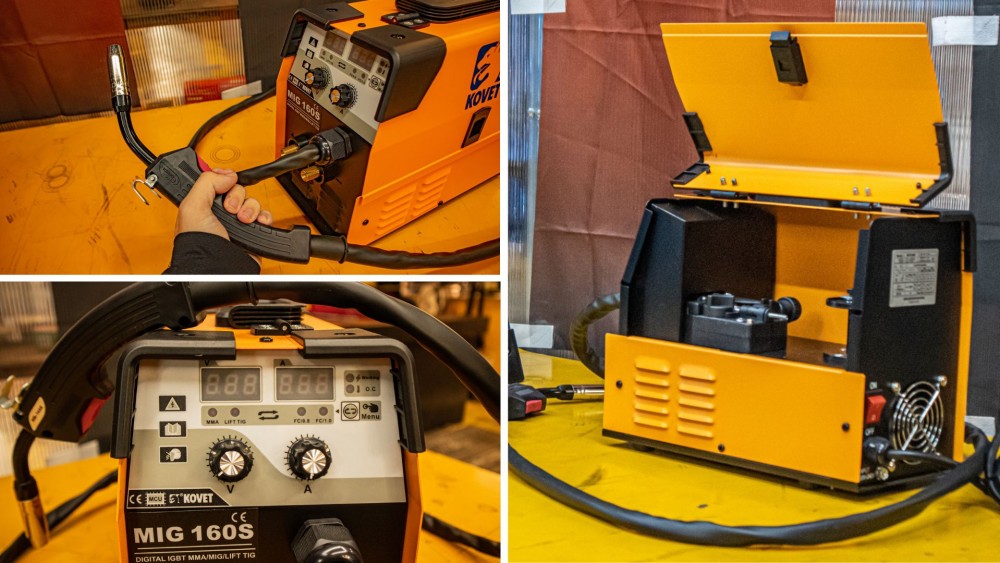
Many modern MIG welders are not limited to just MIG; they often feature 2-in-1 or 3-in-1 multi-process capabilities, incorporating MMA (Manual Metal Arc/Stick) and gasless (Flux-Cored) modes in a single unit. This allows welders to adapt their method to different situations—such as switching to MMA mode when working outdoors where strong winds might blow away shielding gas, without needing a separate machine. Some models even support Lift-TIG welding.
These multi-process capabilities greatly enhance operational flexibility, as some tasks require the deep penetration of stick welding while others call for the smooth, clean finish of MIG. Combining them into one unit makes a MIG welder a truly versatile, all-in-one tool suited for both field jobs and workshop applications.
If You Have a MIG Welder, Why Is the MMA System Still Necessary?
Even with a MIG welding machine, the MMA (stick welding) system remains essential, as both systems meet different application needs. MIG is ideal for jobs that require high speed, smooth and neat weld beads, and consistency in mass production, while MMA remains the heart of welding jobs requiring mobility and durability in environments not conducive to using gas.
Additionally, MMA is easier to use in confined spaces without the need for gas cylinders or continuous wire feed systems, making it a tool that many welders choose to use alongside MIG in actual work. Even though MIG produces neater and more precise weld beads, when facing actual site conditions such as strong winds or imperfect surfaces, MMA remains a dependable and more flexible solution in many cases.
Jobs where MIG welding machines excel
- Mass production: Demands speed and consistent weld beads, reducing post-weld cleanup and grinding steps.
- Thin sheet metal / cosmetic weld jobs: Automotive, steel furniture, and decorative frames requiring smooth weld beads with reduced spatter and porosity.
- Jobs requiring precise heat control: Reduces workpiece distortion, especially on thin sheet steel and stainless steel.
- Versatile materials: Wire and shielding gas can be tailored for carbon steel, stainless steel, and aluminum.
- Jobs requiring high labor efficiency: For applications requiring a fast learning curve, Synergic MIG welders help minimize manual setup errors.
Jobs where MMA (stick welding) still reigns supreme
- Outdoor or windy conditions: No shielding gas to be blown away by the wind, maintaining weld bead quality better in unpredictable weather.
- Dirty surfaces with rust, oil, or galvanized coatings: Certain MMA electrodes are designed to tolerate imperfect surface conditions better than MIG.
- Confined spaces / overhead welding: Compact equipment offering high mobility and easy posture changes.
- Remote on-site repair work: Easy to carry, no need for gas cylinders, wire feeders, or long cable assemblies.
- Specialized jobs: Such as cast iron, where specific welding wires or specialized electrodes provide tailored metallurgical properties.
- Low initial cost: MMA welding machines are affordable, and spare parts and consumables are widely available.
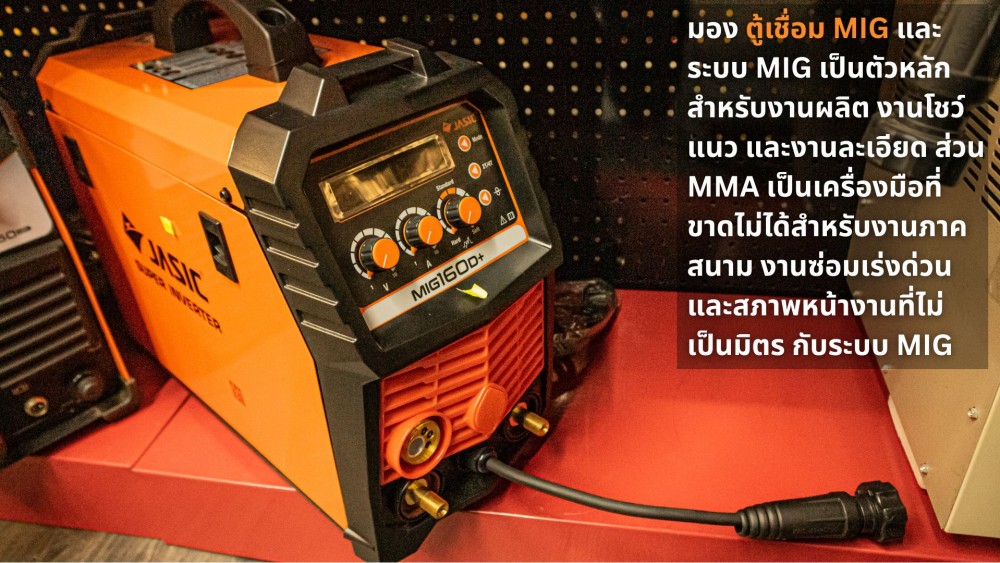
MIG welders are therefore the ideal solution for modern welding tasks. They allow continuous, fast work without frequent stops to change electrodes, produce smooth and aesthetically pleasing weld beads, significantly reduce grinding and finishing time, and lower labor costs since jobs are completed faster with fewer workers. Moreover, they deliver high-quality results suitable for cosmetic welds, structural work, and automotive customization.
It can be said that a MIG welder is a tool that combines speed, beauty, and ease of control in one machine, making modern welding both efficient and aesthetically pleasing at the same time.
However, MIG welders do not completely replace MMA; rather, they "complement" modern welding workflows to make them more versatile, faster, cleaner, and easier to control. Meanwhile, MMA remains the backbone for many applications where MIG is not suitable. Therefore, choosing the right tool for the job context is always the best solution.
What to consider before getting started with a MIG welder?
MIG welders are not as complicated as many think, but there are small details you should know to ensure smooth and safe operation. Just like getting to know a new go-to tool, you need to understand the basics first—from machine settings and material selection to weld pool control techniques.
Precautions when using a MIG welder
- Match the voltage and wire feed speed to ensure a smooth, consistent weld bead and prevent burn-through.
- Beware of wind blowing away shielding gas when working outdoors, as this causes porosity and weakens the weld bead.
- Always clean the welding nozzle and secure the ground clamp tightly to prevent voltage drops or poor weld adhesion.
In addition, understanding user groups and purchasing criteria, such as Know Before You Choose: How to Read MIG Welder Specs in 5 Minutes also helps you operate a MIG welder safely and with maximum efficiency.
Conclusion
In an era where work must be fast, neat, and versatile from a single tool, a MIG welder is the most complete choice. It is no longer just for large factories, but has become an essential piece of equipment for homes and workshops of metalworkers at all levels—from repairing gates and home decor to metal art and design.
Even if you only weld 2–3 times a year, I can tell you that MIG welder is a truly worthwhile investment for modern metalwork.