


 EN
 ไทย


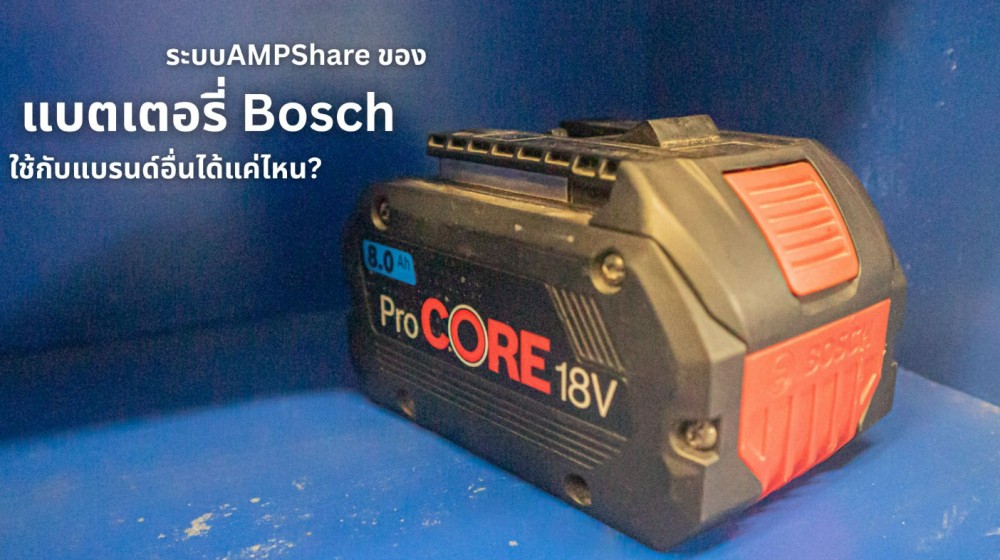
Whether as workers or consumers, none of us want to waste money repeatedly on straightforward things, right? The desire to do everything possible to cut costs, maximize the return on tools invested in, yet maintain standard performance—I completely understand that.
That's why I'd like to talk about an essential component of cordless power tools that many consider very costly: the battery. And if we speak specifically of a brand that has made quite progressive strides in developing shared compatibility systems, it would have to be Bosch Battery and its AMPShare system.
Have you ever wondered when having multiple brands of tools for home or workplace use, and wanting to save costs without having to buy expensive batteries—which mostly have to be purchased separately—whether it is possible to use Bosch batteries cross-brand with other tools like Makita, DeWalt, or Milwaukee?
I've actually encountered this question frequently from friends and customers at the shop. And I must say, it's not a minor issue because it directly involves safety, efficiency, and your wallet. So in this article, let's take another look at whether we finally have batteries that can be mixed and matched, and speak candidly about whether Bosch's latest battery system, called AMPShare, can transform our local power tool industry.
"Using Bosch batteries with other tools" — why does this question arise?
It's no surprise that anyone owning batteries for one tool brand might want to try using them across other brands. In this era, cordless power tools are extremely popular, with every brand competing to launch new tools flooding the market using 12V, 18V, and even 40V Lithium-ion batteries.
The problem is that when choosing to buy tools from multiple brands, we also have to purchase additional batteries and chargers for each brand. These costs are by no means small; just a single Bosch 18V ProCORE battery costs thousands of THB. If you also have Makita, DeWalt, and Milwaukee, just imagine how many tens of thousands of THB you'd have to invest to complete the set?
In addition to high costs, portability is another issue. If you frequently work on-site and have to carry both Bosch batteries and other brands, your backpack or toolbox will certainly be heavy enough to nearly break your shoulders. Having a shared battery system would vastly increase work agility.
Another issue is storage. When you have batteries from multiple brands, you have to line up multiple chargers all over your workbench, not to mention the tangled mess of power cords.
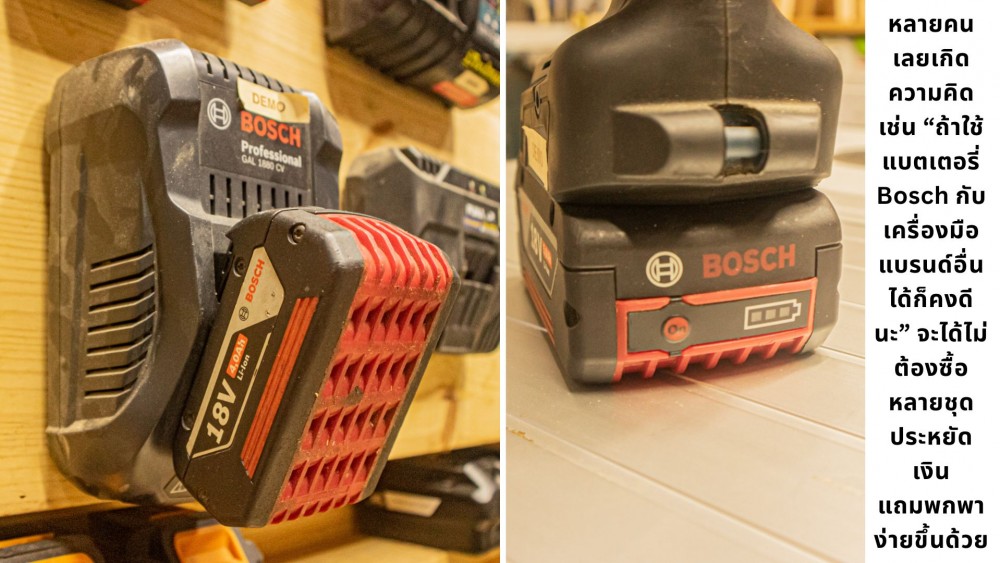
The truth: Can they actually be used interchangeably?
Regarding using Bosch batteries or batteries from the major brands dominating the market today, if you want my straightforward answer, it is: No, it cannot. At the very least, just plugging them straight in is not possible. The main reason is that each brand designs its battery system differently across multiple dimensions, such as:
- Interface design Electrical terminals and locking grooves are different.
- Voltage Even though both claim to be 18V, their internal systems are different.
- Protection Circuit Each brand has specifically designed circuits to control temperature, overcurrent, or short circuits.
Therefore, if you force a Bosch battery into a Makita, DeWalt, or Milwaukee tool, there is a high chance it won't work, or worse, it could cause damage to both the battery and the tool.
What is the Bosch AMPShare battery system?
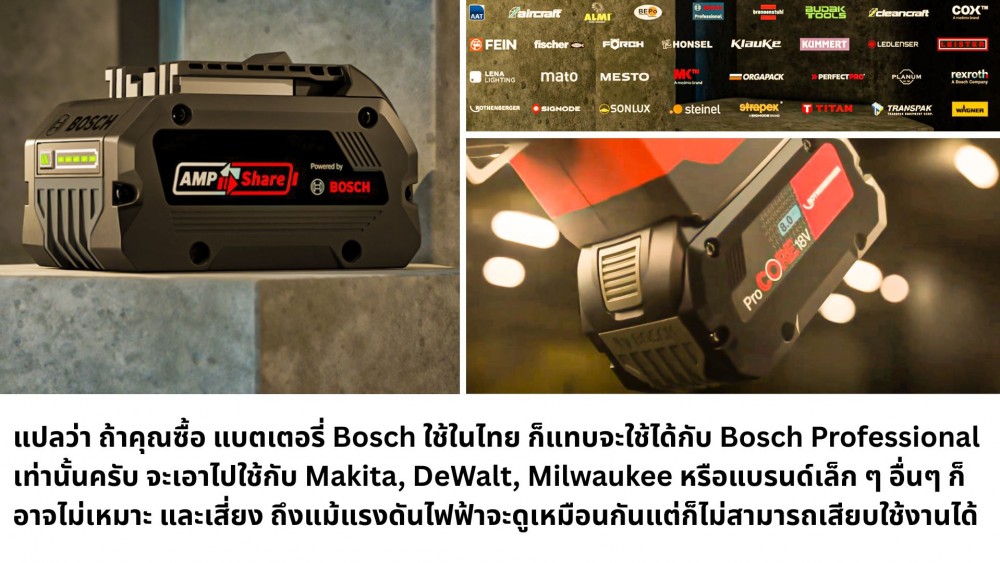
In 2022, Bosch launched the AMPShare (Powered by Bosch) system, based on the Bosch 18V battery platform. AMPShare is like a multi-brand battery alliance that allows various brands to share the same battery platform, such as FEIN, Rothenberger, Ledlenser, Steinel, and other European brands. The good news is that if you already own Bosch Professional 18V batteries, you can use them directly with tools from these partner brands.
Another advantage that must be mentioned is the ability to continuously use newer batteries with older tools, or backwards compatibility Yes, the AMPShare system is designed so that Bosch Professional 18V batteries released since 2008 remain compatible with newer tools within the same system. This makes it a worthwhile long-term investment, eliminating worries that older tools will be left behind.
But… and this is a very crucial "but", these brands barely have any official retail presence in Thailand. Most of what you can find is just Bosch.
So if you use Bosch batteries in the Thai market, how versatile are they?
Speaking from actual experience, we rarely encounter European brands in Thailand. We mostly see a few major players: Bosch, Makita, DeWalt, Milwaukee, along with some Chinese brands or sub-brands like Stanley. However, AMPShare alliance partners like FEIN or Rothenberger, which are niche European brands, do not actively market in Thailand.
Although the overall power tool market in Thailand offers plenty of brands to choose from, AMPShare partners are very hard to find. You will predominantly encounter only Bosch Professional.
So why don't individual brands make batteries cross-compatible?
I've talked to many technicians about this, and everyone wonders the same thing: why don't brands make them cross-compatible? Especially when it comes to Bosch batteries, whose technology is second to none, and it has already been proven that producing cross-brand compatible batteries is completely feasible. There are 2 main reasons:
- Business Strategy If batteries were easily interchangeable, manufacturers would lose out on selling batteries and chargers, which constitute a major revenue stream for brands.
- Safety and Standards Each manufacturer designs different protection systems. Forcing compatibility could compromise safety standards and risk premature battery degradation or fire hazards.
Is there a way to adapt Bosch batteries for use?
Actually, you can find converters or adapters to use Bosch batteries with Makita or DeWalt tools. However, from my own testing and feedback from many users, I have to say it is "not really recommended" very much. Even though it seems convenient in the short run, over the long term it may cause more problems than benefits—including safety uncertified by manufacturers, the risk of immediately voiding the warranty, and tool performance that might not reach 100% compared to using original, brand-specific batteries.
The reason is that most adapters merely connect the electrical terminals without genuine factory protection systems. In case of overcurrent, excessive heat, or battery deterioration, both the tool and the battery could be ruined. Most importantly, your warranty is voided immediately if used with uncertified equipment.
What should you look for when buying a Bosch battery?
Here are a few quick tips I'd like to share to give you a clearer picture. When choosing a Bosch battery, don't just look at the price. You should also consider actual usage patterns, lifespan, and compatibility with your existing tools, because investing in the right battery helps extend tool life and keeps your work running smoothly.
- Choose the model ProCORE for heavy-duty use, as it delivers high power and superior heat management.
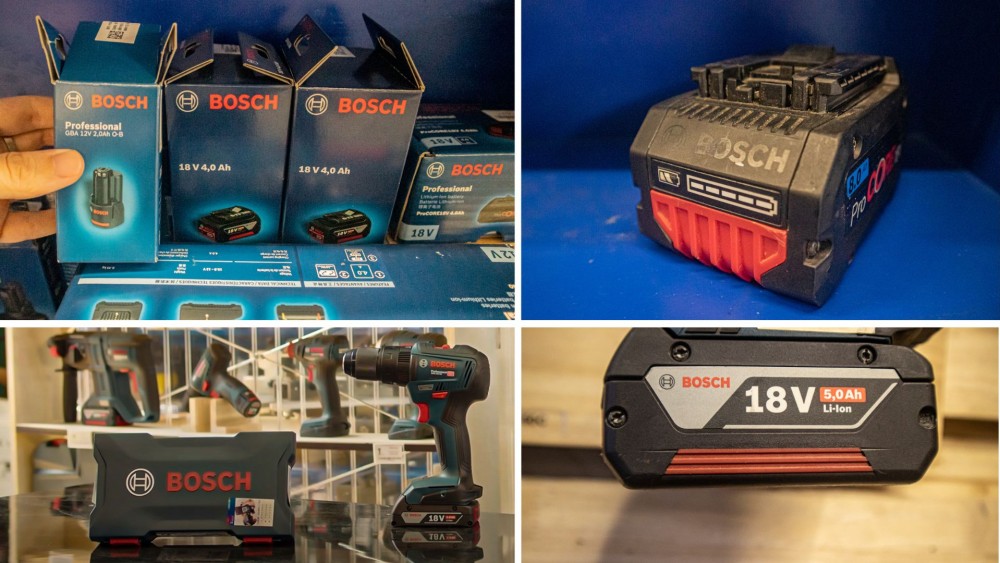
- How much difference do Bosch battery capacities (2.0Ah, 4.0Ah, 8.0Ah) make in real-life use? For general use around the house, a 4.0Ah or 5.0Ah model is sufficient.
- Make sure the tool being used is Bosch Professional 18V (or AMPShare if available in the future).
- Avoid using counterfeit batteries or substandard adapters.
Comparison Perspective with Makita, DeWalt, and Milwaukee
Many people deciding which brand to invest in often compare Bosch batteries with major competitors like Makita, DeWalt, and Milwaukee. This is because these three brands are major market players with comprehensive product ranges, and each features a closed battery ecosystem designed to keep customers within their system.
- Makita Features its own 18V LXT and 40V XGT battery systems, which are completely incompatible with Bosch batteries. However, Makita stands out for its wide variety of tools, especially for construction work.
- DeWalt Uses XR 18V and FLEXVOLT batteries that can switch voltage. Its selling points are durability and high power, but these batteries cannot be shared with Bosch batteries.
- Milwaukee The M18 and MX FUEL systems focus on heavy industrial tasks. The batteries are genuinely durable, but they are also part of a closed ecosystem.
From what we see, it is clear that each brand operates a closed system to keep customers within their respective ecosystems for the long haul.
Summary
So, if the question is: "Can Bosch batteries be used with tools of other brands?" The short answer is no, except with brands in the AMPShare alliance, which are not widely available in Thailand yet. If you are in the Thai market, the most practical choice remains Use Bosch batteries exclusively with Bosch tools.
If you want to switch to Makita, DeWalt, or Milwaukee, you will still need to buy their batteries anyway. There are no easy shortcuts, and forcing the use of adapters carries more risk of damage than it's worth.
I believe many would love a universal battery system that works across all brands, just like how mobile phones have standardized on USB-C. But in reality, the power tool industry is still far from that. At least for now, Bosch has taken a step forward with AMPShare. But for us in Thailand, to get genuine, reliable, and safest performance, sticking to your chosen brand is still the best approach.
What about you? Have you ever tried using cross-brand adapters? Or faced issues with Bosch Battery when needing to work alongside other tools?