


 EN
 ไทย



Customers Also Purchased


Have you ever experienced this… when using Hand Trucks & Carts a supermarket cart, intending to push it straight toward the bakery aisle, but the wheels keep veering left and right, forcing you to constantly steer it back? Or sometimes when using a utility cart at home or in a factory, you park it after moving heavy loads only to find it rolling away on its own, even though the floor is completely flat?
It might sound like a minor issue, but it directly relates to "caster wheel configuration." Carts that look virtually identical can offer completely different pushing experiences depending on how their wheels are arranged!
This isn't just about pushing convenience; it's also about safety and proper application. Choosing trolley wheels that don't match your task can force you to exert more effort, or worse, the items in your trolley might tumble into complete disarray.
Today, Nong Chang will take you on a deep dive into "trolley caster wheel configurations"—something many people overlook, but is actually the key determinant of whether a trolley will be "smooth and agile to push" or "difficult and frustrating to handle."
Why "Trolley Wheel Configuration" Matters
When talking about trolleys, many might think it's just "something with wheels," right? You push it and it rolls, so how different could it really be? But truthfully, the trolley wheels are what determine whether it's "easy to push" or a total "headache to handle."
Just picture pushing a shopping cart at a department store.
- Some carts take sharp turns smoothly around corners and can even turn around in narrow aisles, but when you want to push them straight ahead, you have to constantly fight to keep them from drifting left and right... That's typical of an All Swivel wheel setup that we encounter all the time.
- On the other hand, trolleys used at home or in factories usually roll straight ahead effortlessly without wobbling, though turning takes a bit more effort because they use 2 Swivel + 2 Fixed wheels—considered the most common balanced formula.
- For heavy-duty trolleys carrying heavy loads like beer crates, tool cases, or valuable air conditioner units → trolleys with brakes are essential, because at least when parked, you can be sure that "it won't roll away on its own."
All of these reasons explain why trolley wheel configuration matters. It's not just about good wheels or cheap wheels, but how they are arranged that determines whether a trolley becomes a "helpful companion that makes life easier" or a "nuisance that makes you more exhausted than before."
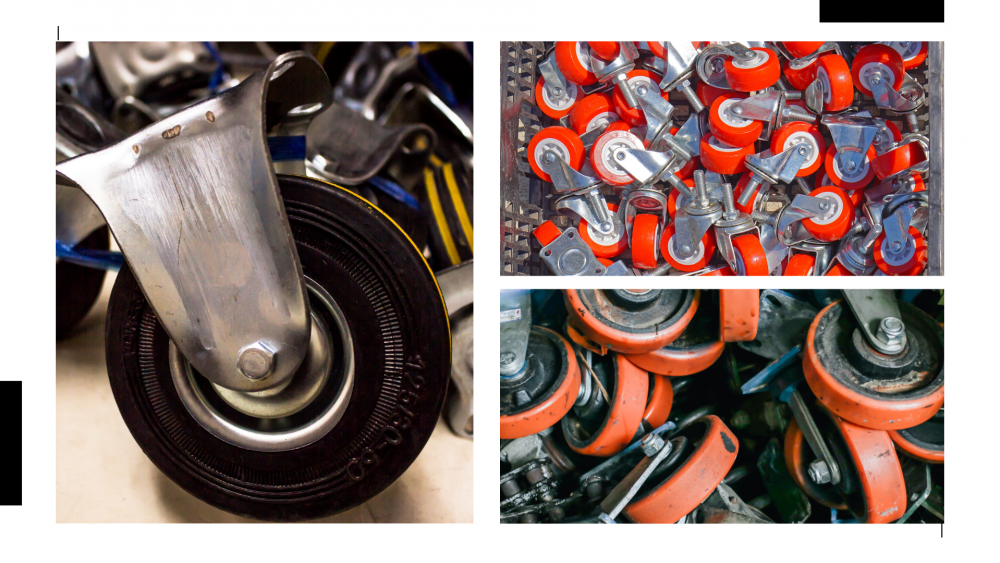
Trolley Wheel Size and Material Also Matter
Besides wheel positioning, the "size" and "material" of the wheels also greatly affect usability.
- Large Wheels → Suitable for rough surfaces such as construction sites and ramps; rolls smoother with less effort required.
- Small Wheels → Agile in tight spaces; ideal for homes, kitchens, and labs, but not suitable for heavy loads.
- Rubber → Quiet and shock-absorbing, but less resistant to abrasion.
- PU (Polyurethane) → The most well-balanced; relatively quiet, high load capacity, and durable.
- Nylon / Hard Plastic → Strong, carries heavy loads, but noisy when rolling
- Steel → Most durable, used in heavy industry, but transmits strong vibrations when pushed
The Most Common Caster Wheel Configurations We See
In fact, there are many caster wheel configurations, but focusing specifically on what we frequently see in everyday life, there are about 2 main configurations that dominate the world. Whether visiting a shopping mall, walking into a factory, or even at home, you will almost always encounter one of these.
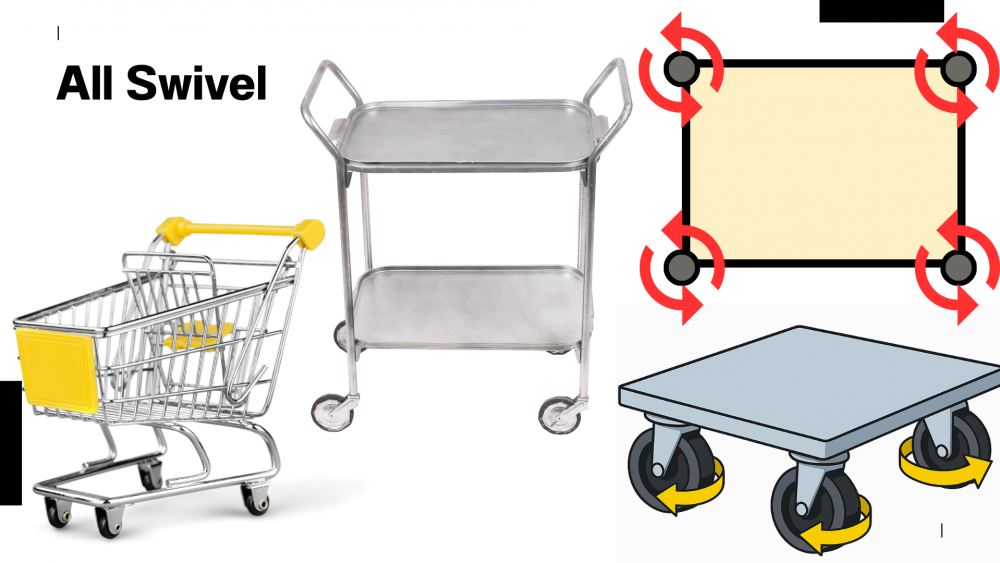
1. All Swivel (All 4 Swivel Casters)
This configuration is considered the most agile of all types because all four casters rotate in all directions, making the cart very easy to steer—it can even spin in place on the spot. → Imagine pushing a cart through narrow store aisles in a mall or making sudden turns in tight walkways; this type of cart fits the bill perfectly.
Pros:
- Turns in a flash, spins around in confined spaces
- Ideal for situations requiring frequent direction changes, such as in retail stores, kitchens, or laboratories
Disadvantage:
- When pushing straight over long distances (such as from a mall out to the parking lot), you will feel it constantly "drifting" sideways, requiring you to continually correct its direction.
- If carrying very heavy loads, it can be tiring because the cart is less stable.
Examples Almost all supermarket shopping carts use this configuration.
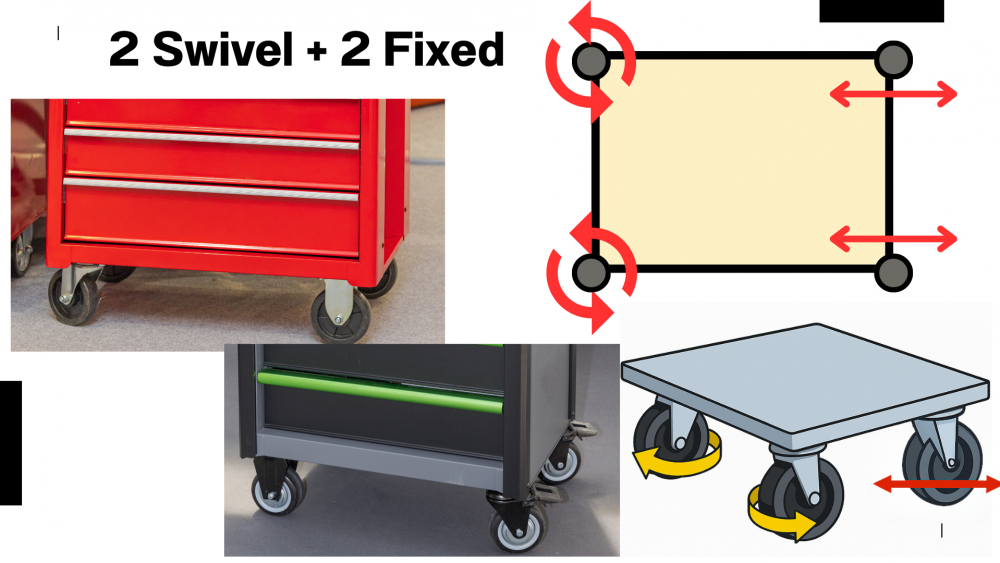
2. 2 Swivel + 2 Fixed (2 Swivel Casters + 2 Rigid Casters)
This is what could be called the most balanced configuration and is popular in almost every field—whether for utility carts at home, hotel housekeeping carts, factory carts, or even technicians' tool carts.
The trick is to "place rigid casters on one side" (mostly at the rear) to make pushing in a straight line much easier than an All Swivel setup, while still having 2 swivel casters at the front to allow turning when needed. → The result is a cart configuration that tracks straight well and still steers easily without being overly tiring.
Pros:
- Easy straight-line directional control; does not drift like All Swivel
- Still turns easily, versatile for a wide range of applications
- Stronger and more stable than having all swivel casters
Disadvantage:
- Not as nimble as an All Swivel cart when spinning around in very tight spaces
- If the route is continuously winding, it may be more difficult to push than an all-swivel setup.
Examples Hotel housekeeping carts, garage tool carts, and heavy-duty home utility carts
Rarely Seen Special Patterns You Should Know
While in daily life we mostly encounter the two main configurations mentioned earlier (All Swivel, 2 Swivel + 2 Fixed), the caster world actually has "special" patterns designed to handle specialized tasks. You might not see them often at home or in supermarkets, but if you work in factories or warehouses or frequently encounter unusual situations, knowing them is beneficial.
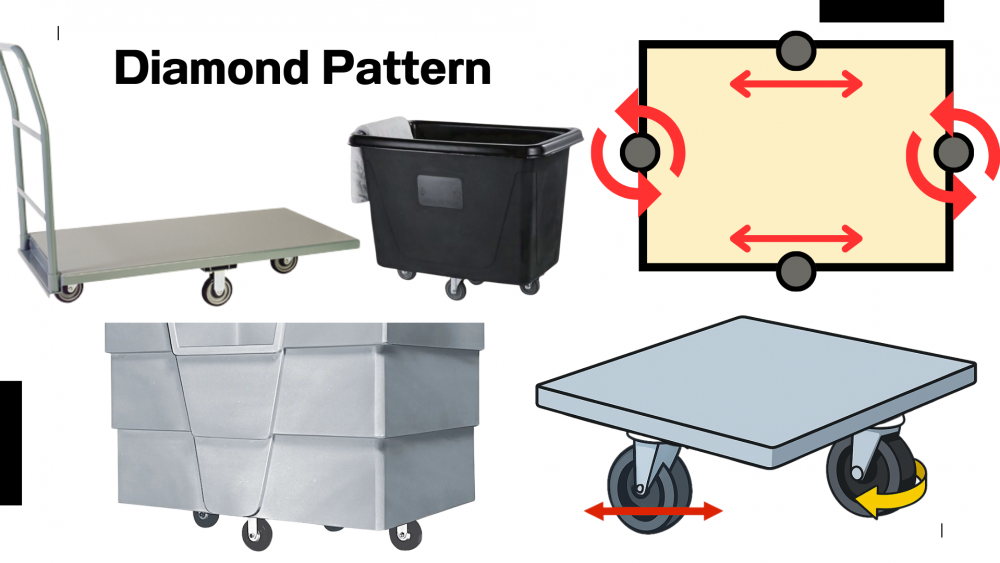
Diamond Pattern
Sounds fancy, right? But it actually means arranging the casters diagonally like the corners of a diamond. Typically, there are 2 Fixed casters in the center and 2 Swivel casters at the front and back ends. This gives the cart a better "center of gravity," making it suitable for uneven floors or areas that require high load capacity.
- Pros: Pushes stably on rough surfaces without wobbling easily
- The downside: Not very suitable for tight spaces because turning is harder than other configurations
Examples: Large industrial carts that need to carry heavy loads
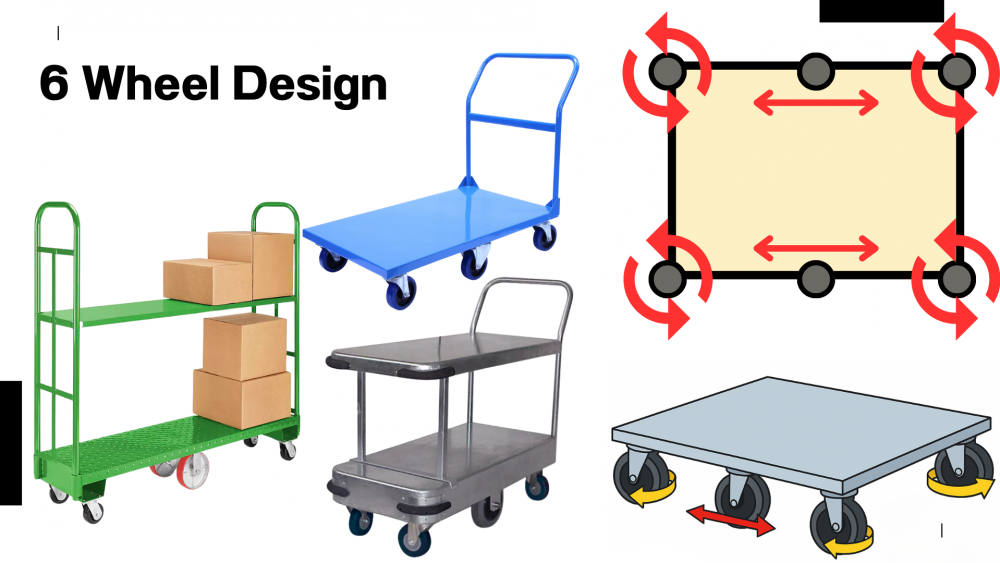
6-Wheel Design (2 Center Fixed + 4 Corner Swivels)
This is the "tank" of the cart world because it's designed for serious heavy-duty loads. The center fixed casters handle the primary load, while the swivel casters at the corners still allow for turning even when fully loaded.
- Pros: High load capacity, the cart won't easily sag or deform
- Disadvantage: The cart is large and heavy, making it clumsy to maneuver in tight spaces
Example: Machinery carts, heavy industrial factory carts
Additional: Special Extra Casters
- Brake Caster → A must-have if used on slopes or with heavily loaded carts
- Directional Lock Caster → Switchable mode from free swivel to fixed straight, ideal for tasks requiring both agility and tracking stability
Fun Fact / Trivia
- Some supermarket carts "Are intentionally misaligned slightly" To make it harder to control → we spend more time in the mall (and buy more things)
- Hospital and lab carts → use quiet wheels (rubber or PU) to avoid disturbing the environment
- Airport luggage carts → require large, ultra-durable wheels to handle heavy baggage and numerous floor joints
Conclusion
See? Just the "wheel configuration" can make a world of difference for a cart. Some prioritize agility, spinning effortlessly in tight spaces; some focus on stability, rolling straight without veering; and others focus on safety, featuring brakes for secure locking. Simply put, every cart has its own "character"—just like cars, where some models are built for city streets while others are made for off-road trails.
The important thing is You need to choose one that truly matches your tasks and the environment you'll be using it in.
- For home use → pick one that rolls straight easily without veering off course
- For shops or confined spaces → prioritize agility
- For factory use → safety and stability are essential
- For special surfaces, such as rough terrain or stairs → choose specially designed wheels
Even after choosing the right "wheel configuration", don't forget that wheel material matters just as much! Rubber wheels may be quiet and smooth but aren't as durable as PU; nylon wheels are strong but rather noisy; and there are many more types to choose from. If you want a complete guide to which wheels suit which floors, read on in this article: Cart Wheel Material Types You Need to Know Before Using Them