


 EN
 ไทย


Customers Also Purchased
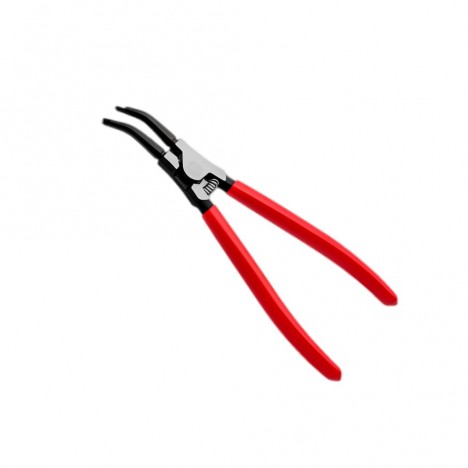


Many people are probably somewhat familiar with circlip pliers, snap ring pliers, or piston ring pliers. They are essentially the same type of pliers, differing only in appearance and application. See >>> What are circlip pliers? What are they used for?

Circlip pliers are a type of pliers that can be further subcategorized based on their characteristics and applications. This article will share information about the different types of circlip pliers and how to choose the right, high-quality circlip pliers for your work.
Main Types of Circlip Pliers
1. External Circlip Pliers
External circlip pliers are used with retaining rings fitted over pins or shafts, which are visible without needing to disassemble many parts. The holes on the retaining ring are on the outside of the ring (pointing outward). Typically, bent tip circlip pliers are used for this job. When you squeeze the handles, the jaws open.
2. Internal Circlip Pliers
Internal circlip pliers are used to remove or install retaining rings inside shafts or piston cylinders. The holes on the retaining ring point inward. Straight tip circlip pliers are popularly used for this work because bent tip circlip pliers have difficulty reaching deep inside shafts or pistons. When you squeeze the handles, the jaws close together.

Other Types of Circlip Pliers
1. Straight Tip Circlip Pliers
These are circlip pliers with long, straight tips, just as the name suggests. The tips come in various sizes. They are extremely useful for reaching narrow and deep spaces, making them very suitable for internal circlips.
2. Angled Tip Circlip Pliers
Sometimes circlips are in hard-to-reach positions. In addition to expanding or compressing the ring, you also need to hook it out, which straight tip circlip pliers cannot do. Therefore, bent tip circlip pliers are necessary for such tasks.
Bent tip circlip pliers are mostly bent at 45-degree and 90-degree angles to the body of the pliers, though pliers with other angles are also available.
In addition to reaching various awkward spots well, bent tip circlip pliers provide a better view of the work area than straight tip circlip pliers because your hand holding the handle does not obstruct your line of sight, eliminating the need to hold the pliers perpendicular to the workpiece. Although mostly used with external rings, they can also handle internal rings that are not located too deeply.

3. Interchangeable/Adjustable Circlip Pliers
This type of circlip pliers is extremely convenient to use because it works with both external and internal retaining rings. The jaws can be freely interchanged. There are models that allow easy adjustment simply by pressing a switch, though typically they involve removing pins or screws.
Interchangeable circlip pliers are suitable for tasks involving multiple types of retaining rings, such as automotive repair work.
This type of circlip pliers is more versatile, but the downside is that they are not as strong as standard pliers because the parts are not permanently fixed in order to allow jaw replacement, and the price is also higher as they are often sold as a set with accessories.
There are also circlip pliers with interchangeable joints, which not only allow switching between internal and external modes, but can also change the plier size.

4. Rack-type Circlip Pliers
Rack-type circlip pliers can lock the expanded distance of the ring in place because where a spring would normally be, it is replaced by a small bar with toothed notches running along it. If you stop squeezing the handles, the pliers stay held in place, preventing the tips from opening or closing further. Alternatively, they may feature a lock-and-release lever similar to a clamp, providing better and more stable jaw width control.
Rack-type circlip pliers provide high leverage, making them ideal for heavy-duty jobs and handling especially strong, large-sized retaining rings. The tips are secured by multiple pins, making them very sturdy, and they can also be removed and replaced. They are available in both internal and external ring styles, with straight and bent tips.

5. Heavy Duty Circlip Pliers
Different from rack-type circlip pliers, these do not rely on squeezing handles, but instead use a screw-drive or gear-driven mechanism. They may look similar to a screwdriver or drive handle, designed specifically for heavy-duty tasks. They offer high leverage while being more compact and easier to use than rack-type circlip pliers.

6. E-ring Circlip Pliers
E-ring retaining rings do not have holes, so standard circlip pliers cannot be used. The tips must be specially shaped to grip and push the ring into place conveniently.
7. Special Tips Circlip Pliers (for rings without holes)
There are many other specialty retaining rings, so circlip pliers must be designed to match them. For handling retaining rings without holes, the tips feature special grooves or contoured surfaces, such as for Constant Section rings or Crescent Rings.

How to Choose Circlip Pliers
☆ Choose circlip pliers that match the type and size of the retaining ring
Many different machines use retaining rings to secure shafts. Consequently, retaining rings come in various types and sizes. You must select the circlip pliers best suited for that specific retaining ring in terms of both type and size.
You should have circlip pliers for retaining rings with diameters ranging from 0.5 mm (0.02 in) to 500 mm (20 in), as these are standard, commonly used sizes. However, for extra-large heavy-duty applications, pliers supporting retaining rings with diameters greater than 100 mm (15.7 in) are typically used.
☆ Choose circlip pliers with an appropriate tip/jaw opening width
Each size and brand of circlip pliers has different minimum and maximum expansion diameters for opening and closing rings, which is an important factor. High-quality plier handles usually specify the range of retaining ring sizes the tool can be used with. Therefore, knowing the retaining ring size allows you to select circlip pliers with a matching diameter capability.
The tip diameter of the snap ring pliers should be as large as possible while still fitting into the holes of the retaining ring, and should not be larger than the ring's hole diameter.
☆ Choose snap ring pliers that can access the position of the retaining ring
Retaining rings are used in many places in machinery. Some are shallow and easily visible, but others are deep inside, out of hand's reach, with standard plier jaws not being long enough. Therefore, you must know where your snap ring pliers will be used. If the retaining ring is placed relatively deep inside a mechanical component, you need straight-nose snap ring pliers with longer tips. For example, a motorcycle's hydraulic master cylinder may require snap ring pliers with longer handles or longer tips than standard pliers.

☆ Choose sturdy and durable snap ring pliers
This is especially essential for heavy-duty snap ring pliers because of the high leverage required. Pliers that are not strong enough may break or bend during use.
Machinery subjected to high axial forces, such as automotive engines, is typically more robust than delicate mechanisms, thus requiring heavy-duty snap ring pliers. Retaining rings in these mechanisms have the necessary strength to withstand high compression and vibration, making removal or installation more difficult. Heavy-duty pliers are therefore the ideal choice.
☆ Choose snap ring pliers suitable for the work environment
If working near areas where electrical currents may be present, use tools with specially insulated handles (note that these are not VDE-certified, as snap ring pliers are not dedicated electrical pliers). In addition, pliers should not be used on excessively hot components or exposed to temperatures higher than normal, as this can soften the pliers or their coating, causing them to become brittle, crack, or break easily.
☆ Choose snap ring pliers suitable for your frequency of use
If you need to work with retaining rings of various sizes but do not use them frequently, consider snap ring pliers with interchangeable tips, as they offer versatility over sheer strength.
However, if you are a professional technician using snap ring pliers regularly, choosing high-quality, durable fixed-tip pliers is more cost-effective in the long run. Also, look for thick, cushioned handles, as they provide comfort and prevent hand fatigue during extended use.
Read article circlip pliers, More ->>> 