


 EN
 ไทย


Customers Also Purchased

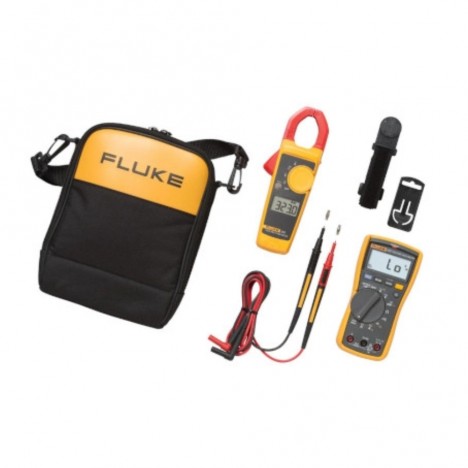

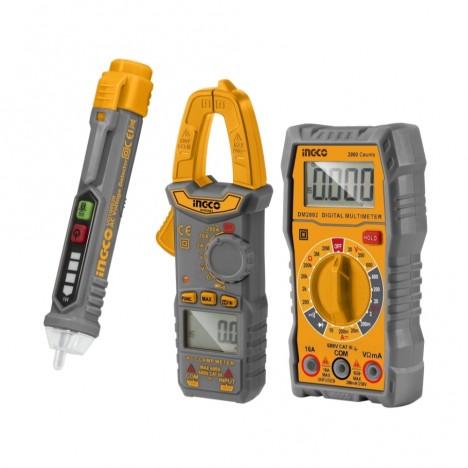

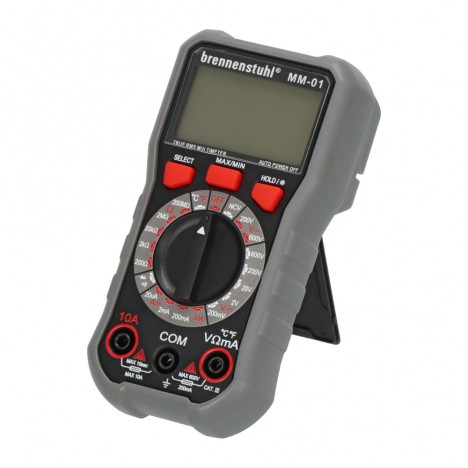
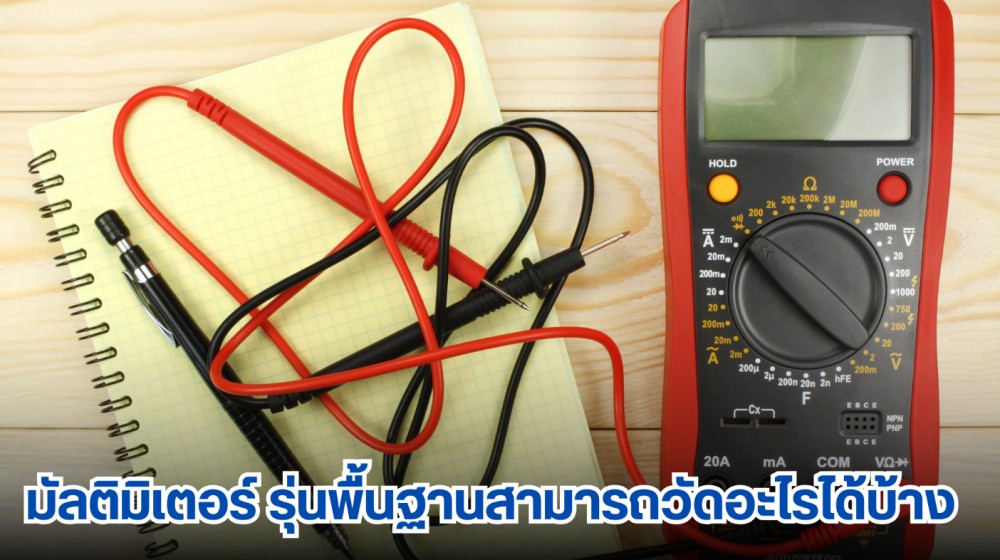
"In the world of electricians, nothing is more important than a precision measuring tool... and one of those is the 'Multimeter'!"
In an era where everything costs money, having a device that lets you check your home electrical systems yourself without calling a technician is well worth it, isn't it? Multimeters is the answer! And you don't even need to spend thousands on an expensive model, because just a "basic multimeter" can fully cover all your general usage needs.
In this article, we'll take you through the various functions a multimeter can perform—whether measuring AC/DC voltage to test power outlets or batteries, measuring resistance in wires and resistors, measuring electric current to check electrical loads, or even testing diodes and broken wires. Once you finish reading, you'll feel confident picking up a multimeter for real-world use and appreciate just how much time and money this little device can save you.
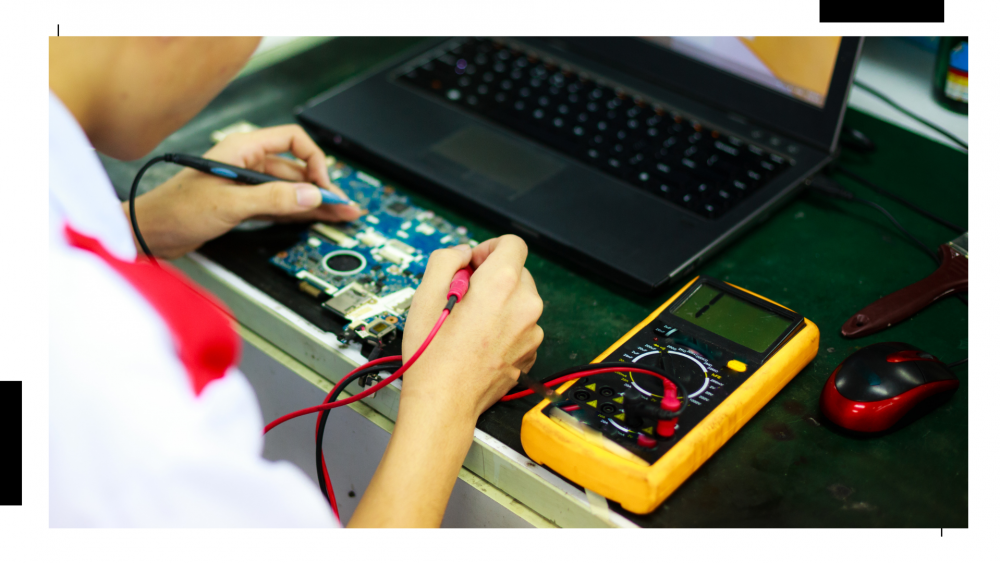
1. What is a Multimeter?
A multimeter is a fundamental tool used to measure electrical properties. The word "Multi" means "many" and "Meter" means "measuring device," combining to mean "a device that measures multiple electrical values in one instrument." Typically, a multimeter can measure at least 3 primary values:
- Voltage
- Current
- Resistance
Tips from the technician
Another name for a multimeter is an AVO Meter, which stands for:
- A = Ampere (Current)
- V = Volt (Voltage)
- O = Ohm (Resistance)
This name was popular in the past, especially with analog (needle) meters that could measure 3 values: A, V, and O. Nowadays, the term "Multimeter" is more commonly used because modern tools can measure far more than just three parameters.
For the general public without a background or job in electrical work, a multimeter might seem like a tool strictly for electricians or engineers. In reality, a multimeter is an excellent tool for troubleshooting home appliances, such as checking if a battery is still usable, testing if an outlet is live, or finding out if a wire is broken—basic tasks that anyone can perform.
Additionally, multimeters are divided into 2 main types:
- Analog Multimeter: Uses a pointer needle to indicate values on a dial scale, requiring visual reading. It is suitable for measuring rapidly changing values, such as fluctuating signals, but is harder to use.
- Digital Multimeter: Displays readings as numbers on an LCD screen. It is easy to read and simple to use, making it much more popular today.
Multimeters can be found commonly at electrical supply stores, hardware shops, or even some stationery stores. Prices range from tens to thousands of THB, depending on functionality, accuracy, and build materials.
Technician's Tip:
Entry-level multimeters may have lower accuracy than professional-grade models, making them ideal for general inspections such as checking batteries, measuring outlet voltages, or testing wire continuity. However, they are not suitable for tasks requiring high precision, such as industrial instrument calibration or highly sensitive electronic measurements.
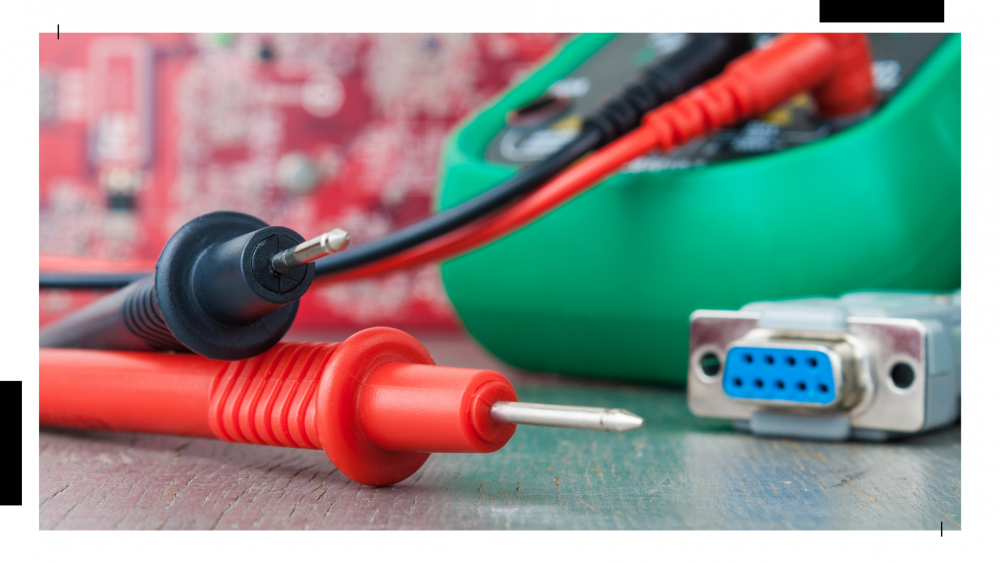
2. What Can a Multimeter Measure?
2.1 Voltage Measurement
Voltage is the potential difference between two points in a circuit, measured in volts (V). Voltage measurement is essential because it indicates whether "power" is present in the circuit and how high that voltage is.
Multimeters can measure both:
- DC (Direct Current) such as batteries and electronic circuit power supplies
- AC (Alternating Current) such as standard home electrical systems and power outlets
Example applications:
- Checking whether an AA battery has a voltage around 1.5V or is depleted
- Measure 9V batteries for remote controls or wireless microphones
- Measure household electrical outlets to see whether the AC voltage is at 220V
- Check phone chargers to verify whether they actually output power
Voltage measurement involves "touching two points" with test leads, without having to break the circuit or change lead positions. It is the easiest and safest method for beginners.
2.2 Measuring Electric Current
Electric current is the amount of electrons flowing in a circuit, measured in amperes (A). Measuring current requires "connecting the meter into the circuit in series" so that the current flows through the multimeter.
Multimeters have dedicated jacks for measuring current. Some models feature jacks for both low current (mA) and high current (10A); plugging into the wrong jack can short-circuit the meter or blow the fuse.
Example applications:
- Measure how much current each electrical appliance uses (helps in calculating electricity costs)
- Check whether circuit boards or electronic modules are drawing abnormally high current (e.g., microcontrollers or Wi-Fi modules)
- Measure battery charging to check whether current is flowing in
Technician's Tip: Measuring current is not suitable for beginners without sufficient basic knowledge, as incorrect connections can short out the meter or damage equipment.
2.3 Measuring Resistance
Resistance is the opposition to the flow of electric current, measured in ohms (Ω). A multimeter can be used to measure how much resistance an object or circuit has, helping to verify "whether the circuit is connected properly"—such as checking if wires are fully connected or broken anywhere.
Example applications:
- Check whether wires or plugs are broken
- Check resistors to see if their values match what is specified
- Check circuit continuity to see if it is still functioning properly
Special feature in this mode: Many multimeters have a "continuity beep" function that emits a sound when the measured object has a good electrical connection, such as checking whether a plug truly connects to the end of a wire without having to look at the display.
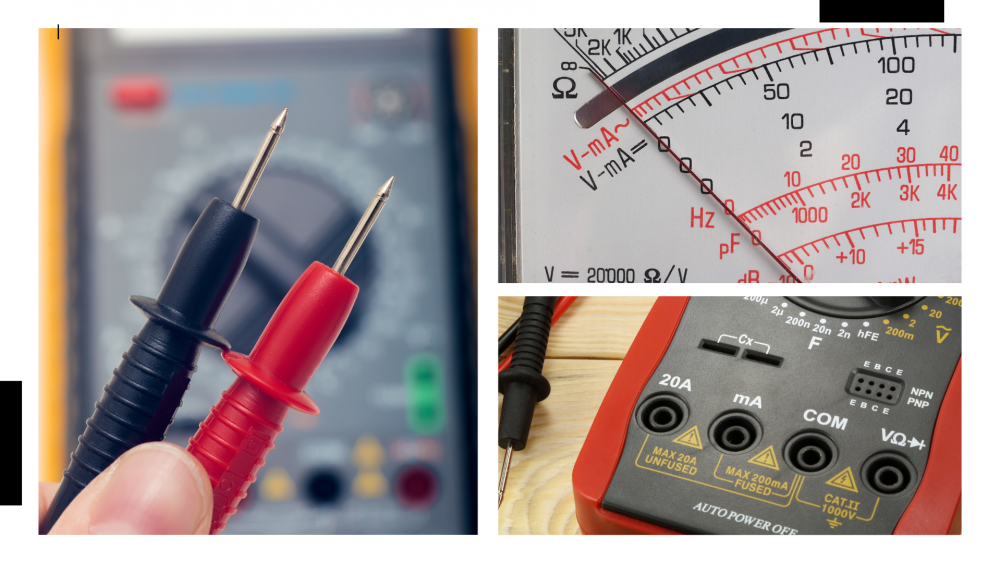
Range Selection Techniques
Range selection is something that many beginners tend to overlook, but in reality, "setting an appropriate range" is a critical factor for accuracy and safety in electrical measurements.
Why do you need to set the range?
Standard multimeters have multiple measurement range levels (e.g., 200Ω, 2kΩ, 20kΩ, 200V, 600V, etc.), each representing "the value range the device can read accurately." If the range is set too low for a high value, the meter may be unable to read it, display an incorrect value, or even get damaged (if it lacks protection circuits).
Techniques for setting the proper range
1. Not sure? Start high
If you don't know the approximate value you are measuring, always start from the "highest" range. For example, when measuring DC voltage, set it to 600V first, then step down level by level, such as 200V → 20V → 2V, to achieve higher resolution.
2. Gradually lower the range for accuracy
Once you know that the measured value does not exceed a certain threshold, lower the range for a more detailed display. For example, if you measure a 1.5V battery on the 20V range, you can switch to the 2V range to get more decimal places.
3. Do not use too low a range
If you set the range lower than the actual voltage or current—such as measuring 220V household electricity on the 20V range—the meter will be unable to read it, may "flash the reading", or display "OL" (Over Limit).
4. Always pay attention to the units
Some people misread values by confusing units, such as measuring current in mA (milliamps) but reading it as A (amps). Always check the unit indicated on the display screen.
5. Choose Auto Range if available
Some multimeter models feature an Auto Range function that selects the range automatically, reducing hassle. However, with a manual model, you must set it manually every time.
Precautions for beginners
A multimeter is an easy-to-use and extremely useful tool, but improper use can be dangerous, potentially causing meter damage or even an electric shock to the user. Beginners should carefully understand the following precautions:
1. Setting the wrong mode can damage the device
For example, if you set the meter to "Current measurement" mode (A) but probe a household outlet to measure 220V voltage, it can immediately cause a short circuit, blow the fuse, or destroy the device because the internal circuitry for current mode is completely different from voltage mode.
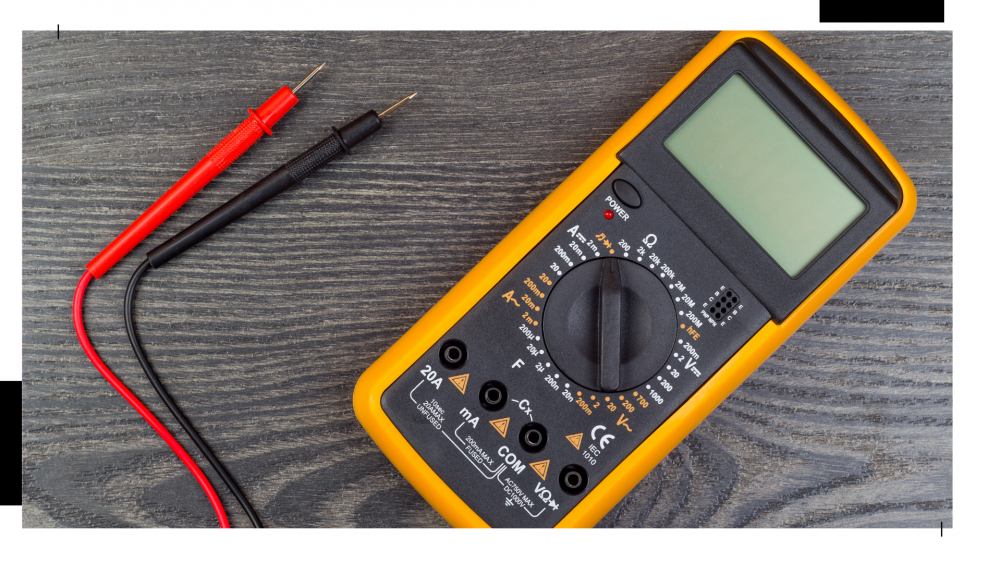
2. "Avoid measuring household AC current" with a standard multimeter
This is a critical point that general users often misunderstand, thinking that "a multimeter can measure the current of a wall outlet," which is incorrect. and Unsafe
Why shouldn't you measure household current directly?
- Measuring electric current requires the current to flow "through the multimeter itself", unlike measuring voltage which only requires touching the probe tips.
- If the circuit being measured draws too much current (e.g., an iron, water heater, etc.), it may cause the multimeter to short circuit, blow a fuse, or catch fire
- Incorrect wiring can cause electric shock or explosion if you lack sufficient electrical knowledge.
- General multimeters usually support a maximum current of only about 10A, whereas many household appliances consume more than that.
If you really need to measure household current: You should use a dedicated tool called a Clamp Meter, which can measure current without breaking the circuit and is safer because it simply clamps around the wire.
In simple terms
- Measuring "Voltage" from a household outlet → Can be done by setting to V~ mode
- Measuring "Current" at a household outlet → Avoid unless using a Clamp Meter
3. Be careful not to plug the test leads into the wrong jacks
Multimeters mainly have the following probe jacks:
- COM (common) For the black test lead – used with all modes
- VΩmA For voltage, resistance, and low current modes
- 10A (if available) For measuring high current
Plugging into the wrong jack while measuring may cause the meter not to work or display incorrect values. Always double-check before measuring.
4. Do not measure resistance while the circuit is live
Measuring resistance must be done on an unpowered circuit, because if voltage is still present, it may damage the multimeter or yield inaccurate readings.
5. Do not use in wet areas or with wet hands
Avoid measuring electricity in damp conditions or with wet hands, because a multimeter is an electrical device. If water gets inside or contacts moisture, it can cause an electric shock or a short circuit.
6. When in doubt, do not force a measurement
If you are not sure which mode to use, how to connect the circuit, or whether you are using the right equipment, read the manual thoroughly first or ask someone with experience. Never guess, because a mistake in electrical measurement may not only damage the meter, but could also cause serious personal harm.
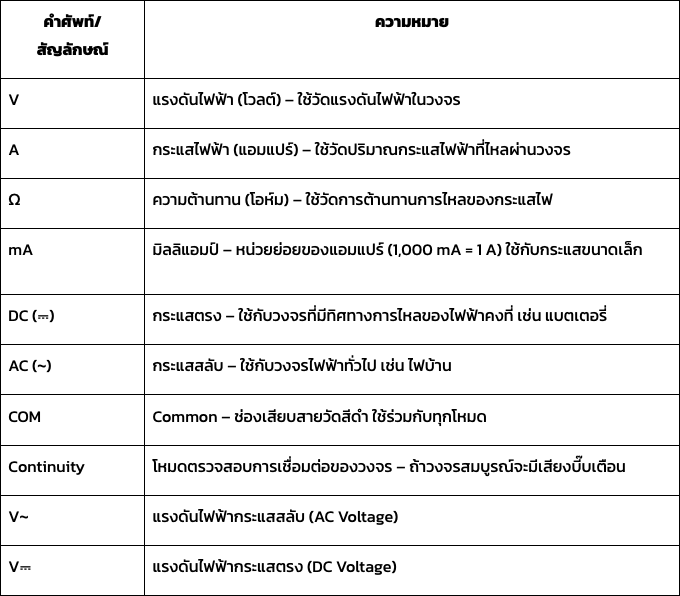
Basic terminology to know before using a multimeter
To help you better understand the dial and various functions, here is a summary table of commonly encountered terms and symbols.
Conclusion
Multimeters A basic multimeter is a simple yet powerful tool used to comprehensively measure voltage, current, and electrical resistance. Even with no technical background, you can learn to use it safely just by knowing how to set the right range and being mindful of common mistakes—especially in current measurement mode.
Once you understand the basic terminology and operating modes, you will be able to confidently use a multimeter to check your home electrical system, troubleshoot basic problems, and save on technician costs.