


 EN
 ไทย


Customers Also Purchased


Anyone familiar with craftwork who holds a drill every day knows there are countless types of drill bits, right? Since drills are used to drill through various materials and make holes of various sizes, whether a drill can handle a job often doesn't depend on the tool itself, but almost entirely on the bit. Drill bit designs must prioritize their intended use, resulting in a vast array of multipurpose and specialized bits.
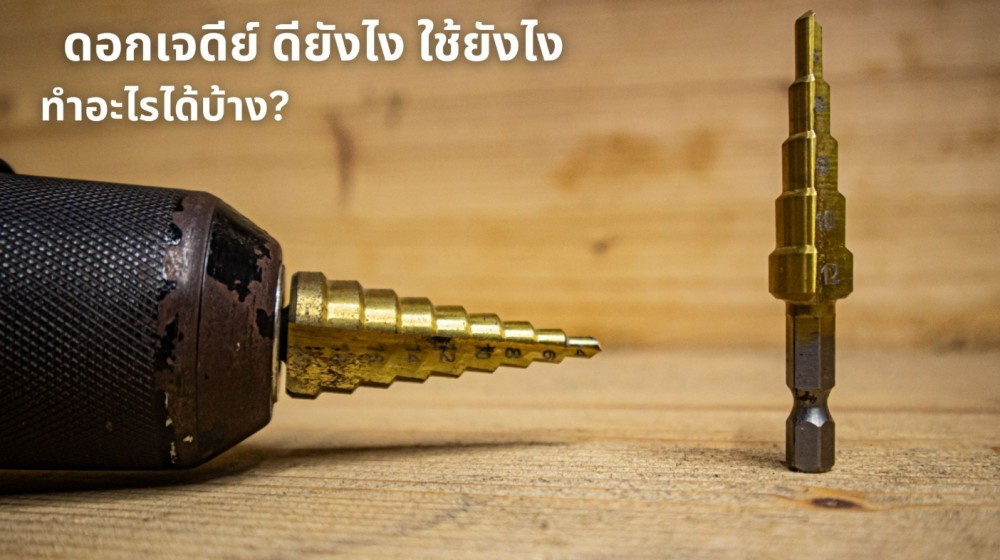
What if I told you there's a type of drill bit that doesn't even look like a drill bit, yet almost everyone agrees belongs in every toolbox? That's right, I'm talking about Step Drill Bit the step drill bit, also known as a pagoda bit.
When walking through hardware stores or browsing tool websites, many people have probably seen a step drill bit (or "pagoda drill bit") in eye-catching packaging. With its cone shape stacked in stepped levels like a pagoda, that's where its Thai name comes from. The first time I saw a step drill bit, I didn't even know it was used with a drill; I thought it was a hole-measuring tool.
To some, it might look like a niche tool. But once you really get to know it, you'll realize that the step drill bit is a versatile secret weapon that overcomes the limitations of standard straight-shank drill bits. Seeing it, many might wonder what it is, what it does, and why it's better than standard drill bits. In this article, let's explore the benefits of step drill bits and the types of jobs they're used for.
What is a step drill bit?
The shape of a step drill bit is quite striking. At a glance, it looks like a stacked cone arranged in steps, which is why English refers to it as a "step" bit. Its standout feature is the ability to drill multiple hole sizes with a single bit by drilling step by step. As it rotates deeper, the larger steps gradually cut away the material until it reaches the desired hole diameter.
What can a step drill bit be used for?
Have you ever had to drill thin sheet materials like sheet metal to uniform hole sizes, or work on a material that already has holes that just need enlarging to a consistent diameter? Or needed to drill various hole sizes without the hassle of constantly swapping bits? It might not sound like an everyday issue, but for electricians routing wires, installers, or plumbers, it's far more common than you think.
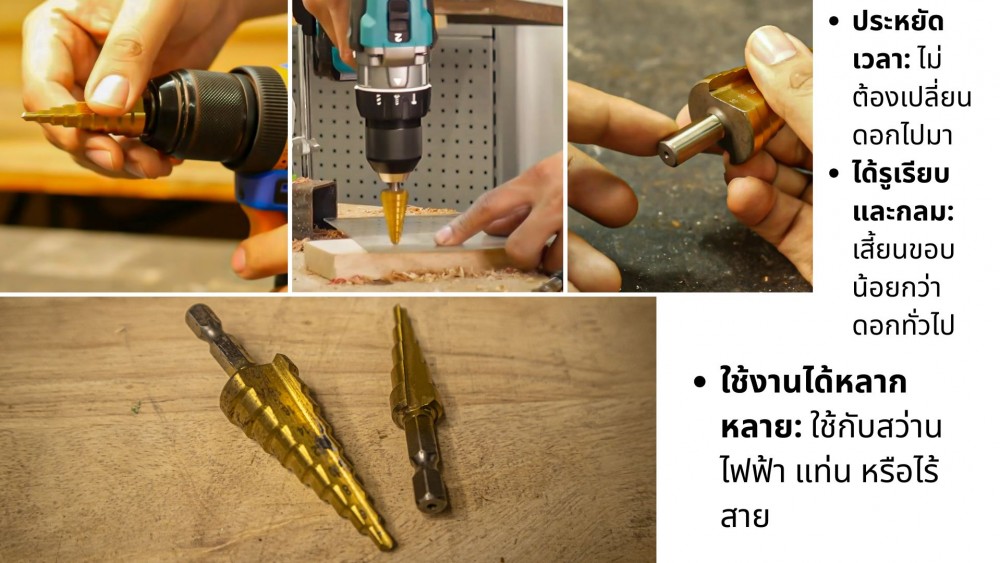
Drilling multiple hole sizes in a single workpiece is where step drill bits truly shine. Whether drilling a small hole or gradually enlarging it, you can do it easily with just one bit without wasting time swapping bits repeatedly.
The primary job of a step drill bit is drilling thin sheet metal, such as steel, stainless steel, aluminum, or brass. That's because the resulting holes are cleanly round with minimal distortion compared to conventional twist drill bits.
- Drill through multiple hole sizes with a single bit, no bit changes required
- Enlarge existing holes to larger sizes with ease
- Usable on a wide variety of materials, deforming thin sheets much less than twist drill bits
Key advantages that make it stand out
Now that you're familiar with step drill bits, let's look at their key highlights. They offer more advantages than you might think, and some make the work so much easier that many tradespeople never want to go back to conventional methods.
What sets a step drill bit apart from standard twist drill bits is convenience and the quality of the finish. First of all, it saves time and eliminates the hassle of carrying multiple drill bits just to drill a few holes—a single bit lets you drill continuously.
Second, the holes produced are smooth, round, without flared edges, and with minimal burrs. Third is versatility: it works with electric drills, drill presses, or cordless drills. And finally, value: one bit covers multiple sizes, so there's no need to buy and store separate individual bits.
Many electricians and installers agree that these advantages make the step drill bit an essential tool they carry to almost every job site, big or small. It gives them confidence that whenever they need to drill or enlarge holes across various materials—such as routing wiring through stainless steel enclosures in factories or acrylic panels at home—having one bit that does it all saves both time and money.
Limitations
After hearing all these benefits, some might say, "Then we don't need multiple drill bits anymore! Why not just use a step drill bit for everything?" But wait: step drill bits are multipurpose, and by nature, versatility comes with certain trade-offs. We already mentioned that on thin materials, this bit is a champion. By now, many of you can probably guess what that implies: yes, its major weakness is thick materials!
For example, if you need to drill through steel several millimeters thick, a step drill bit might not cut deep enough, and there's a risk of the hole edges burning or the bit wearing out faster than a standard twist bit. Furthermore, if the job requires precise, consistent-depth drilling, specialized drill bits remain the better choice.
Therefore, you should choose a step drill bit based on its strengths: enlarging holes, drilling thin sheet metal, plastics, or even wood if it's just a few millimeters thick. However, for heavy structural drilling or very hard materials, other types of drill bits are still necessary for safety and durability.
- Not suitable for drilling very thick materials
- Higher price than conventional drill bits
- Improper use may lead to premature damage
Techniques and Buying Guide
To achieve good results when using a step drill bit, there are a few handy tips to keep in mind. For instance, select the appropriate rotational speed for the material: softer materials can be drilled at higher speeds, but harder metals like stainless steel require low speeds and steady, moderate pressure.
Applying cutting fluid or lubricant also helps reduce heat buildup that affects bit life. Furthermore, always clamp the workpiece securely to prevent it from spinning with the bit. Lastly and most importantly, drill step by step rather than forcing through all at once to ensure clean, neat holes and avoid premature wear on the bit.
- Select the appropriate rotational speed for the material
- Use lubricant when drilling hard metals
- Clamp workpiece securely to prevent it from spinning with the bit
- Drill step by step; do not force through in a single push
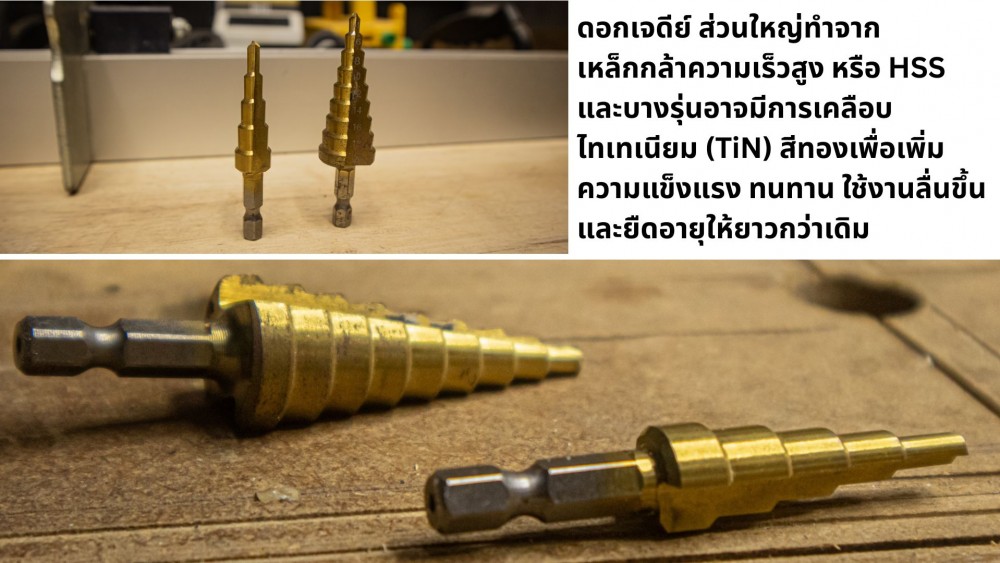
When choosing a step drill bit, several factors should be considered, starting with the base material. Standard HSS is sufficient for general-purpose tasks, but for higher durability, a TiN-coated version provides superior wear resistance.
- Material: Standard HSS or TiN-coated HSS
- Size: Available in various size ranges as needed, such as 4–12 mm, 4–20 mm, and 4–32 mm
- Number of steps: More steps cover a wider range of applications
Step Drill Bit Maintenance
Many people wonder how to store and care for frequently used step drill bits to maintain sharpness and extend their service life. Without proper attention, tools like this can wear out very quickly, so proper maintenance is just as important as correct usage. Primarily, clean off metal swarf and chips after use. When transporting them, store in a dedicated case to protect against impacts. Crucially, avoid misusing them on unsuitable materials such as thick wood or concrete. Just like with other drill bits, inspect the sharpness regularly; if dull, resharpen or replace as needed.
Who Are Step Drill Bits Ideal For?
Whether you are an electrician needing to enlarge knockouts in electrical panels, a factory maintenance technician drilling thin sheet metal, a pipe installer sizing holes to fit fittings, or a DIY enthusiast working with plastics and acrylics, step drill bits easily satisfy all these needs—saving time and delivering clean, professional results.
- Electricians → For enlarging holes in electrical enclosures/panels
- Maintenance technicians → For drilling thin sheet metal
- Plumbers/Pipe fitters → Make holes for fittings and joints
- DIY enthusiasts → Drill plastic or acrylic
User Experiences
People who use a step drill bit for the first time often say unanimously, "I should have bought this a long time ago." That's because it noticeably speeds up the work without needing to swap bits multiple times. The finished work looks neater, and investing in a step drill bit set feels far more worthwhile than expected.
I had the chance to talk to professional technicians, and many agreed that step drill bits genuinely reduce hole flare and metal burrs, making work that requires neatness look much more refined. They mentioned that for anyone working regularly with sheet metal or aluminum, a step drill bit is a must-have item. Otherwise, you waste time and materials on minor mistakes that could easily be avoided simply by choosing the right drill bit.
Some technicians shared that right from the very first use, they could immediately feel how much cleaner the results were. When enlarging holes in confined spaces, it saved them a ton of time. Meanwhile, another craftsman who frequently works with metal pipes noted that step drill bits give him the confidence that work won't be ruined—even in rush jobs, the output still turns out looking good and sturdy.
These experiences further reinforce that step drill bits aren't just tools bought to look cool, but are essential aids that make a craftsman's work easier and ensure greater confidence in quality every single time they are used.

Summary
The key strengths of a step drill bit are drilling multiple sizes with a single bit, delivering smooth hole edges, and offering ease of use. While there are limitations with thick materials and a higher price compared to standard drill bits, if used correctly and well-maintained, it can be an incredible game-changer for your work and an indispensable go-to item in your toolbox.
Step drill bits epitomize versatility in modern drilling tasks. Many view investing in just one set as truly covering the need for multiple hole sizes without the burden of carrying dozens of drill bits in a heavy toolbox, making workflows significantly more agile.
This is why some technicians compare Step Drill Bit to a "shortcut" in their daily tasks.