


 EN
 ไทย


Customers Also Purchased


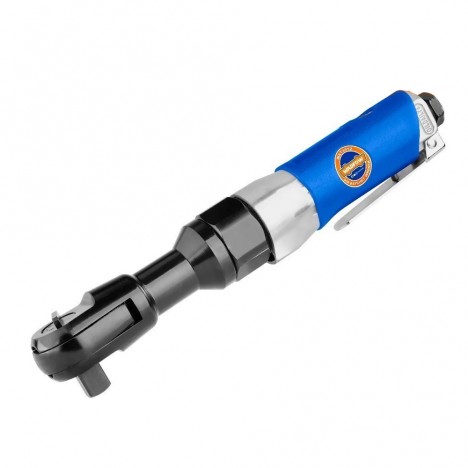

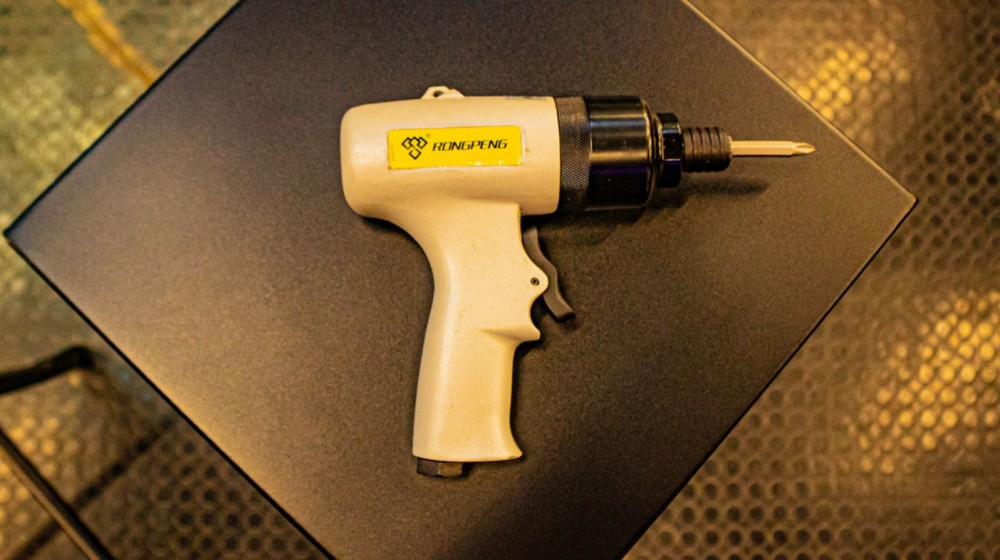
Among the wide variety of body styles available, pistol grip and straight inline air screwdrivers are the two most common types, each with its own advantages, disadvantages, and suitability for different applications. In this article, we'll dive into the differences between both types of air screwdrivers to help you choose the right tool for your work with confidence.
Basic Understanding of Air Screwdrivers
Before we dive deeper into each type of air screwdriver, it's important to first understand the fundamentals of this power tool. An air screwdriver isn't just a typical screw-driving tool, but a device with its own unique operating mechanism, offering distinct torque and speed advantages clearly setting it apart from electric or manual screwdrivers.
In addition, air screwdrivers play an essential role in manufacturing and assembly industries that require speed, precision, and consistency when driving screws. Understanding how air screwdrivers work will help you select, use, and maintain the tool much more efficiently.
General Construction of an Air Screwdriver
An air screwdriver consists of a body housing an internal air motor connected to an air compressor via an air hose. The operator controls its operation by pressing a trigger to supply air to the motor. As the motor spins, it transmits power to the bit holder, allowing fast tightening or loosening of screws.
Types of Air Screwdrivers
Air screwdrivers come in several configurations designed to meet diverse application requirements, especially through ergonomic designs that make work more comfortable for operators and reduce muscle fatigue during continuous use. Choosing the right style of air screwdriver should therefore take into account the working posture, frequency of use, and the characteristics of the workpieces being fastened.
The 2 main types of air screwdrivers most commonly found in industry and general mechanic work are straight type and pistol grip type, both of which have distinctly different highlights and characteristics.
Straight (Inline) Type
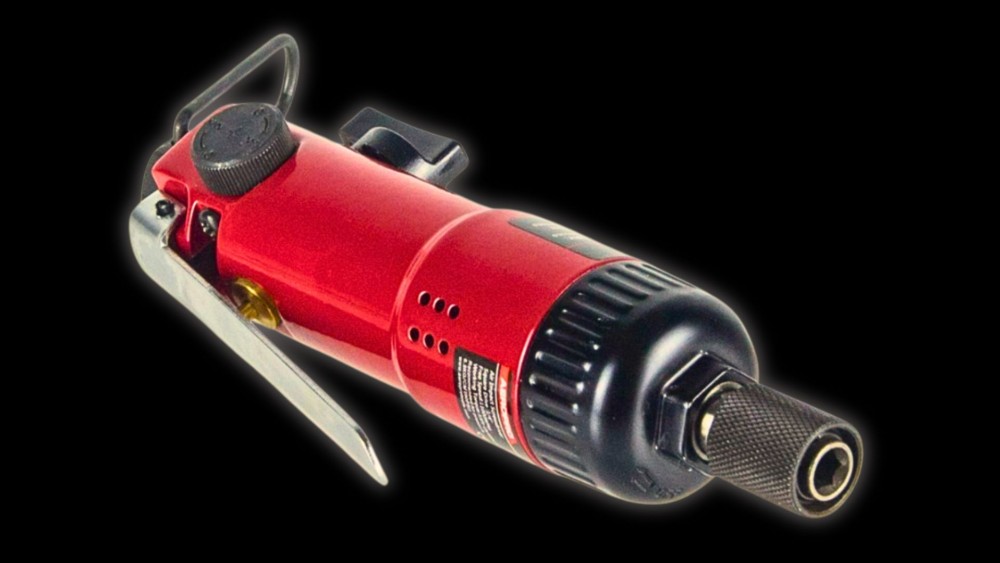
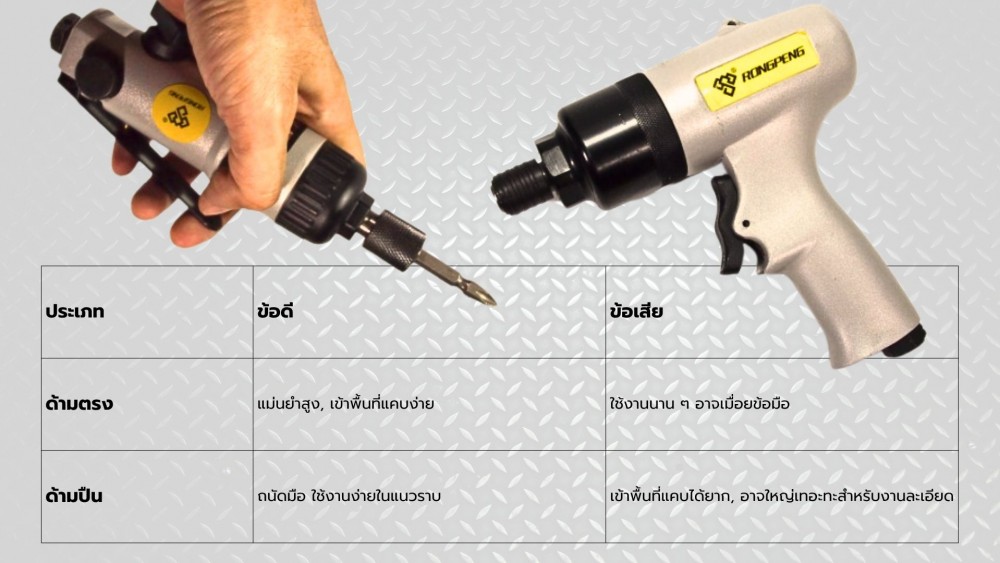
Straight inline air screwdrivers feature a slim, straight profile along the tool body, similar in appearance to a standard manual screwdriver. They are typically used in a straight or vertically downward orientation, making them ideal for high-precision tasks such as electronics work or assembling small parts in tight or hard-to-reach areas. The design aligns the tool body with the bit holder, providing more precise control over direction and downward pressure, which reduces the chance of the screw head slipping or stripping during fastening.
The advantage of a straight inline air screwdriver is that it can be used in locations where space constraints preclude the use of larger tools, such as inside electrical control boxes, narrow machine channels, or overlapping assemblies. Additionally, straight inline air screwdrivers are suitable for those who prioritize lightweight handling and the agility of rotating the tool directly from the wrist, although they may require more downward finger and wrist force during continuous use.
Pistol Grip Type
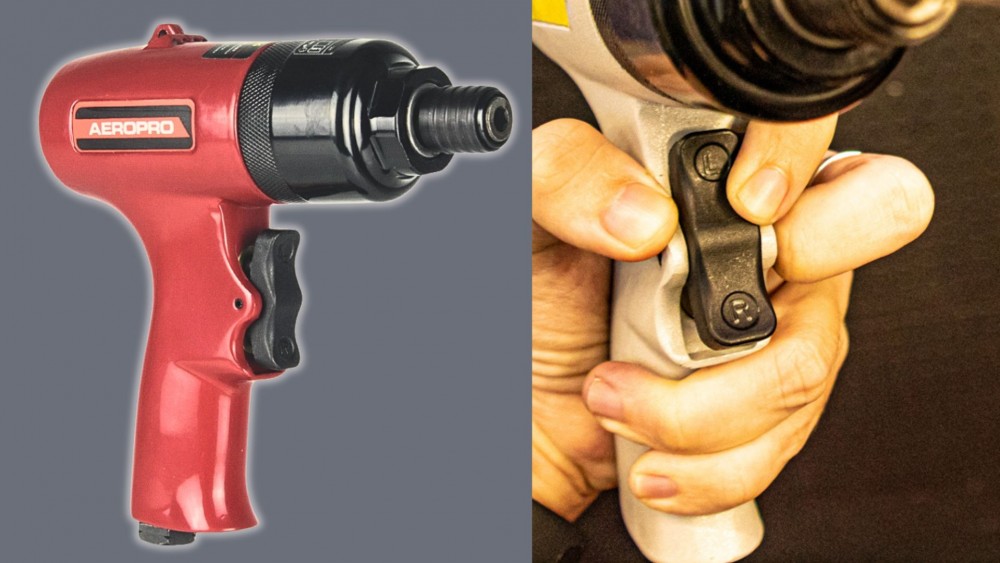
Pistol-grip pneumatic screwdrivers resemble a handgun, featuring a handle perpendicular to the tool body, where users hold the handle and press the trigger with their index finger to operate. This design allows users to control the tool more easily when working horizontally or downward, making it popular in industries requiring continuous repetitive screw fastening, such as the manufacturing of electrical appliances, furniture, or automotive parts.
With the handle positioned perpendicular to the tool body, users can transfer downward pressure directly onto the screw head through the palm. This helps reduce long-term wrist fatigue and also minimizes the chance of the bit slipping off the screw head during operation. This capability is extremely beneficial for jobs that require speed while still demanding precision, such as assembly line installations or assembling structures that require firm fastening.
Additionally, pistol-grip pneumatic screwdrivers are suitable for users who need to operate tools all day, as the ergonomic shape provides a secure grip and reduces kickback during continuous screw driving. It is considered an excellent tool for boosting work efficiency and reducing physical strain.
Comparison: Pistol-Grip vs. Straight Pneumatic Screwdrivers
When it comes to choosing pneumatic screwdrivers for tasks with diverse ergonomics and driving angles, many people often hesitate between straight-handle and pistol-grip pneumatic screwdrivers. Both types possess distinct advantages that effectively meet user needs in various situations. Comparing the pros and cons of each type is therefore crucial for users making decisions to select a tool that delivers accurate and efficient performance.
This section compiles the strengths, weaknesses, and operating characteristics of both pneumatic screwdriver types in detail, enabling readers to analyze which tool is best suited to their specific work requirements and work environment.
Ergonomics Design
- Straight handle: Suitable for tasks requiring high precision, such as delicate work, electronics, or tight spaces. The inline grip design aligns with the rotating bit, allowing for precise control, though prolonged use may cause wrist fatigue.
- Pistol grip: Fits comfortably in the hand for general applications, especially horizontally or vertically downward. Suitable for those working continuously for long hours, offering direct downforce from the wrist, which provides better torque control in certain situations.
Convenience of Use
- Straight handle: Suitable for tight spaces, such as inside electronic enclosures or navigating corners in control cabinets with limited room.
- Pistol grip: Suitable for fastening tasks requiring high downforce or work positioned directly in the user's line of sight, such as assembly tables or horizontal walls.
Torque Control
- Both pneumatic screwdriver types can be equipped with automatic torque control systems. However, for high-torque applications—such as structural or engine work—pistol-grip air screwdrivers offer more stable force control due to better grip positioning and force transfer.
Speed and Efficiency
- The rotational speed of both pneumatic screwdriver types is comparable, depending on the model and air pressure. In practical use, however, pistol grips are often better suited for jobs demanding speed and power, while straight handles excel in delicate and meticulous work.
Durability
- Both pneumatic screwdriver types offer comparable levels of durability if chosen from reliable brands and properly maintained. The key point to consider lies more in the nature of the application.
Who Is the Pistol-Grip Pneumatic Screwdriver Suitable For?
For those who need to work continuously all day, or are in industries that require fastening large numbers of screws quickly and accurately, a pistol-grip air screwdriver is the optimal choice. With an ergonomic grip and a handle design that helps distribute pressure directly from the wrist to the screw, it allows for stable operation without causing quick fatigue like other screwdriver styles.
It is suitable for work requiring high torque, horizontal work with ample operating space, and repetitive fastening tasks—such as structural assembly, factory furniture assembly, or even industrial machinery maintenance—where speed, precision, and consistent control are needed throughout the operation.
Additionally, users who want convenient directional and torque control without excessive wrist bending will benefit more from a pistol-grip air screwdriver than from other types. It is no surprise that professionals across many industries trust this type of air screwdriver as their primary tool on the workbench or assembly line.
- Factory maintenance technicians: Used for horizontal or vertical fastening tasks
- Furniture assembly work: Requires fastening multiple points continuously; helps reduce fatigue
- Structural or machinery work: Requires high torque; convenient to use due to a comfortable grip
- Work requiring prolonged handheld use: The pistol grip effectively reduces pressure on the wrist
Who is a straight-type air screwdriver suitable for?
A straight-type air screwdriver is a popular tool among users who require high delicacy and precision, especially for work involving small parts or electronic devices where workspace is limited. Its slim, linear body allows easy access to deep or confined spaces, reducing the risk of damaging workpieces during fastening.
The straight-handle profile also facilitates use in various orientations—whether vertical, horizontal, or angled—which is frequently encountered in electrical installations, control boxes, or assembly line manufacturing that demands fine torque control, particularly in production processes requiring uniform and precise torque across every fastened component.
This tool is also ideal for those needing a lightweight, easy-to-use unit that is convenient to position or mount on robotic arms or automatic tool balancers on production lines. It is an excellent choice if you are looking for an air screwdriver that delivers both delicacy and long-term efficiency.
- Electronics technicians: Delicate work, circuit assembly, fastening in confined spaces
- Work requiring access to tight spaces: Such as fastening inside electrical boxes and control panels
- High-precision work: Reduces bit slippage and screw head damage
- Users working in various postures/angles: Especially diagonal lines or awkward angles
Conclusion: Whichever you choose, an air screwdriver will be a great help
Whether it's an inline or pistol-grip air screwdriver, these tools each have their specific roles and suitability, as both designs are tailored to accommodate different types of work. Choosing the wrong type could cause delays, errors, or fatigue from awkward postures, ultimately affecting long-term work efficiency.
Selecting an air screwdriver that matches the nature of your work and operating posture is essential. It not only enables fast and accurate screwdriving, but also reduces muscle fatigue and extends the lifespan of both the tool and the operator. A well-considered decision is not just about convenience, but also impacts overall costs and work quality.
Those looking to invest in long-lasting tools should consider all aspects, including direction of use, frequency of use, required maneuverability, and even personal preference. Making the right choice from the start is key to completing tasks quickly, minimizing damage, and setting high standards for every job.
If you thoroughly understand the differences, you will be able to choose air screwdrivers the one that best suits your work with confidence